SL Police Special Task Force personnel continuing on the anti-terror operation "Definite Victory" (Niyathai Jaya) in Ampara district captured two more LTTE camps located inside Kangikadaichi Aru jungle last evening (Monday the 29th of January).
The STF sources said that they have found a large food storeroom and a medical unit in the two LTTE camps captured deep inside the woods in Gangamuwa area.
A large stock of medicine and dry foods believed to be donated by INGOs were also found inside the camps. Two double cabs, a van, a mini truck, three motorbikes and few generators are among the other items recovered in the latest phase of the operation.
In September 2006, the STF personnel launched their first anti -terror move in to Ampara district since the signing of 2002 CFA. Since the beginning of last year, the LTTE stepped up violence in Ampara, Thirukkovil, Akkaraipaththuwa, and Bakmitiyawa areas disrupting the normalcy.
The terrorists re-launched their ethnic cleansing campaigns against Sinhalese and Muslim civilians , while the Tamil civilians in Ampara were subjected to a massive recruitment drive that marked with large number of abductions and assassinations.
The STF , the government's only paramilitary has hitherto destroyed 20 odd LTTE strong hold located in the jungles in Ampara district during its operation.
following list of items were recovered at the Medical Center and the food storage captured by the STF personnel during the Operation.
At The Medical Centre
Two Double Cabs loaded with medicines
Three Motor Cycles
A Van (Dolphin)
A Double Cab (Nissan)
A Tractor
A Generator (20Kv)
Three Generators (2.5Kv)
Ten beds
Large quantity of Medicines
An Oxygen Cylinder
Office Equipments
A 21' TV
And at the Storage
Fifty two Rice packs
Twelve tents
Twenty five plastic buckets
(http://www.nmatnet.com/news/index.php?subaction=showfull&id=1170166273&archive=&start_from=&ucat=)
Tuesday, February 20, 2007

Sri Lanka elite forces capture LTTE’s medical center
Sri Lanka’s Special Task Force yesterday captured LTTE’s medical center from Kanchikudichcharu along with a store of food items, the military said.
. “On a search operation conducted by the STF, troops found the LTTE medical centre called ‘Puvi Master’ and a store of foodstuff,” a military official said.
STF troops on reaching the location found that terrorists who were cooking meals had just left and fled the area, leaving behind a score of items including two double cabs, three mortar cycles, one dolphin van, one Nissan double cab, one tractor, three generators, service equipment, one oxygen cylinder, medicine, one TV set and furniture.
In the store that was captured there were 52 gunny bags of rice, 12 camping tents, 25 plastic baskets, stocks of medicine and a large number of empty bags with WFO emblem.
(http://www.colombopage.com/archive_07/January30132249JV.html)
Monday, February 19, 2007
Kanjikudichchi-aru offensive enters critical phase, one more base overrun by Shamindra Ferdinando
The ongoing counter-insurgency operation in the Kanjikudichchi-aru jungles has entered a decisive stage with police commandos targeting small groups of terrorists operating in the area.
"We are actually in the third phase of the offensive," a senior para-military officer told The Island yesterday. Although commandos engaged in the offensive forced the LTTE to abandon almost 20 bases along with a large quantity of supplies, small groups are believed to be re-grouping.
The current phase of the offensive was aimed at wiping out them, he said. Aggressive patrolling would continue to seek out and neutralize the enemy units.
Commandos on Thursday engaged two enemy groups at Udimbikulam and Darampalawa. According to the STF official commandos the first contact had taken place at Udimbikulam where commandos overran an LTTE hideout subsequently identified as Jeevananda base. "We hit them hard," the official said that subsequent inquiries revealed that five LTTE cadres had succumbed to their injuries. Commandos had recovered one multi purpose machine gun with 300 rounds of ammunition, 24 hand grenades, two communication sets and a large stock of rice, dhal and sugar.
The second confrontation had taken place at Darampalawa where police commandos ran into an LTTE ambush. One commando had been wounded and evacuated to the government hospital at Ampara. His condition is reported to be stable.
Commandos had also located a caterpillar and an earth moving vehicle near the LTTE base located on January 29.
The expert acknowledged that the setting up of new permanent bases would take place as aggressive patrols seek LTTE cadres who had lost their permanent bases. He expressed the belief that the LTTE would try to side-step the ongoing operations. "They would subsequently mount attacks on isolated bases and foot patrols," he said. "In fact, we have adopted a similar strategy. We are setting up new bases and sending out patrols to scour the surrounding jungles."
The official pointed out that there was a huge difference between jungle operations and fighting in built-in areas. Since the launch of the offensive the LTTE threat on Sinhala and Muslim areas had lessened, he said.
(http://www.lankaweb.com/news/items07/030207-8.html)
STF's Repeated Attempts to Protect Ampara From the LTTE
On 19th February 2002, exactly five years ago, the STF was on a 72 hour ambush in the Kanchikudichchiaru forest reserve in Ampara to trap few LTTE cadres in hiding. The ambush suddenly came to a halt even before accomplishing its mission. The STF's attempt to protect Ampara from the LTTE had to be abandoned with the signing of the Cease Fire Agreement three days later on 22nd February 2002. The ambush on 19th February 2002 was not the STF's first attempt to drive out the LTTE. Their efforts date further back to 1991.
The STF launched a massive operation in Kanchikudichchiaru in 1991 following the LTTE massacre of 600 policemen in Thangavelayudapuram in 1990. The STF recovered the remains of the massacred police personnel towards the end of 1990. Intelligence sources had confirmed that the LTTE had just begun to establish camps in the area. After a successful operation, the STF dominated the area till 1995. However, due to political blunders the STF couldn't hold ground. To fulfill a short sighted political strategy, the STF was once again compelled to abandon the liberated Kanchikudichchiaru area to support the 'Riviresa' operation launched on 17th October 1995 to liberate the Jaffna peninsula and to wrest control of the A-9 road.
The STF withdrew from Kanchikudichchiaru opening the doors for the LTTE to gain control of the area again. Ever since 1995, the LTTE has been growing from strength to strength in Ampara controlling the daily life of civilians.
Today, after 15 years of its first attempt, the STF has once again regained control of a considerable area of the Kanchikudichchiaru forest reserve. The 'Niyathai Jaya' operation launched on 4th January 2007 is the STF's third attempt in clearing the Kanchikudichchiaru.
The Special Task Force under the ‘Niyathai Jaya’ operation has captured over 20 LTTE bases and satellite camps. On 1st February 2007 the STF captured the "Jeewananda Base” of the LTTE used for cadre training. Intelligence sources had confirmed that the tigers were using this base to train conscripted children while attacking the Security Forces at regular intervals.
Intelligence sources had also confirmed that the LTTE had planned to link the Eastern coastal belt from Vakarai to Verugal with Thoppigala and Kanchikudichchiaru in Ampara.
The Special Task Force launched the Niyahai Jaya operation on 4th January to liberate the Kanchikudichchiaru forest reserve from the LTTE. Speaking to MCNS, the Director Operations of the STF, SSP Ajith Wickremasinghe said that the presence of LTTE cadres in Kanchikudichchiaru had posed a serious threat on civilian settlements in the vicinity. The LTTE backed by infrastructure facilities in the area was controlling the daily life of Sinhalese, Tamils and Muslim villagers. Complaints from the public against the LTTE’s abductions, extortions, forced recruitment, illegal timber, cannabis and ivory trade were on the rise, he further said.
On 18th December 2006, a group of LTTE terrorists abducted 22 school children and two teachers from a tuition class in Tirukkovil, Ampara. Civilian sources confirm that the children were forced into a van at gun point. The van was seen speeding towards the Kanchikudichchiaru area. Among the abducted school children were 7 boys and 15 girls. Following the abduction, a LTTE spokesman was quoted by foreign media as saying that the mass abduction of schoolchildren at Tirukkovil was a “serious mistake”. However, the LTTE was later compelled to release the school children due to enormous pressure exerted by their parents and the media.
On 2nd January 2007 in BAKMITIYAWA, a postman, his wife and two others (all Sinhalese) were abducted and killed by the LTTE. Subsequently, an 18 year old boy, Dayananda was abducted by the LTTE and the STF launched a search operation to find the boy. Later on the students of the MADAWALALANDA MAHA VIDYALAYA staged a protest against LTTE abductions.
The legendary eastern granary
Further, LTTE atrocities have denied farmers from using the KANCHIKUDICHCHIARU tank for irrigation. Fertile land in Pavattakulam, Vattamadu, Rufaskulam, Venmeadikulam, Kottevihara and Thangavelayudapuram, historically known as Deeghavapi has been denied for paddy cultivation by the LTTE.
Legend says that King Dutugemunu sent his brother to cultivate in the Deeghavaphi area. The abundant harvest and prosperity of Deeghavapi earned it the name, ‘The Granary of the East.’ According to legend, King Dutugemunu had visited the area and used water from the tank to prepare kanji, a thick broth made out of rice, coconut milk and water. Thus the tank is known as Kanchikudichchiaru, meaning ‘Kanda biuwa oya’ in Sinhala. In Tamil ‘kanji’ refers to thick broth while ‘kudingal’ and ‘aru’ means drinking and river respectively.
The STF says that the rocky area of Gandamegoda still bares evidence of ancient Buddhist shrines. Evidence also suggests the existence of Buddhist monks in ancient times. However, much of these sites have been plundered and destroyed by vandals.
On the first day of the 'Niyathai Jaya' operation, the STF sealed off the entry points to the Kanchikudichchiaru area. Police Commandos advancing from four directions cleared the area up to the LTTE cemetery. Then they set up satellite bases around the area. Following the establishment of satellite bases troops pulled back surprising the enemy. The STF was backed by the Air Force Kfir jets that bombarded the area ahead forcing the LTTE cadres to flee in disarray. In some LTTE satellite bases pots of rice and cooked food had been left behind by fleeing tiger cadres.
Day 6 and 7 of the 'Niyathai Jaya' operation brought heavy rains to the Ampara district. STF commandos couldn’t advance ahead of the cemetery due to heavy rains. However, they got the support of the Sri Lanka Army to bombard tiger hideouts with barrages of artillery amidst heavy rains which left the LTTE in total disarray. SSP Ajith Wickramasekara said that they knew exactly where LTTE camps were located. ‘Niyathai Jaya’ operation is based on a combination of “strong intelligence and tactics”, he further added.
Inside the Kanchikudichchiaru forest reserve certain LTTE camps have been located within a high security zone under thick forest cover with 24 hours of electricity supplied by 50 KV and 25 KV generators. These camps were believed to have been used by LTTE leaders. Evidence also indicates that access to these camps had been restricted to ordinary LTTE cadres.
The PARAMANANDA base had been used by PARAMANANDA MASTER, the LTTE leader in charge of explosives. The STF recovered a 29" Flatron TV and a DVD player from the PARAMANANDA camp. From other bases used by leaders, STF troops recovered 29" Flatron TVs, generators, Nissan vans, double cabs and satellite phones. According to the STF, most of the luxury vehicles left behind by the LTTE were booby trapped to cause maximum damage to advancing police commandos. However, the STF has been successful in overrunning LTTE camps with minimum casualties to own troops.
Elite cops also recovered around 30 generators both portable and fixed, water pumps, and other vehicles from the overrun LTTE camps along with 4 main storerooms packed with large quantities of tsunami aid including canned food, dry rations, sanitary, tents, large number of mosquito coil packets and sleeping bags. Almost all LTTE underground bunkers were roofed with sand bags made out of tsunami aid sacks.
To the surprise of the STF some infrastructure that the LTTE had been using inside Kanchikudichchiaru carried the names of some INGOs.
| LTTE forced recruitment The youth who succeeded in escaping the second time said “They shaved our heads and gave us black T shirts to wear and then we were ordered to build bunkers and clean up the camps and move things” Today, the STF has cleared a considerable area of the Kanchikudichchiaru forest putting an end to abductions, forced recruitment, extortions, illegal timber and ivory and cannabis trade. “The key reason to launch ‘Niyathai Jaya’ was to chase away the LTTE from this area. The LTTE was a huge threat on people in this area. Once the area is cleared people could peacefully engage in their livelihood and use the natural resources of this fertile area without any intimidation or harassment from the LTTE” S.S.P. Ajith Wickramasekara said. He also said that the STF is planning to rebuild the infrastructure so that people could engage in paddy cultivation especially in the legendary eastern granary of Deeghavapi. |
(http://www.nationalsecurity.lk/fullnews.php?id=4234 )
Friday, February 09, 2007
Raiding Kafirs leaves Swarnam's base in tatters
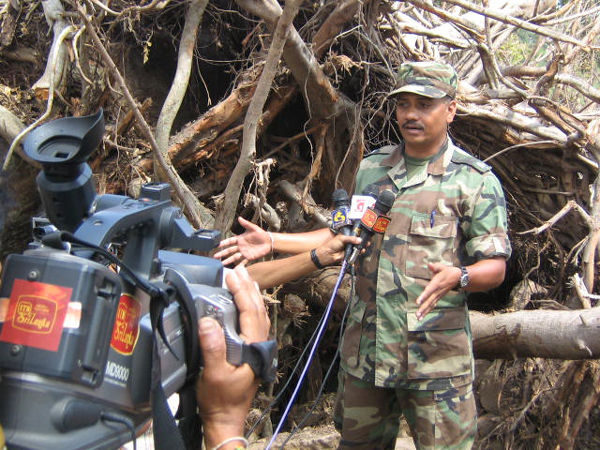

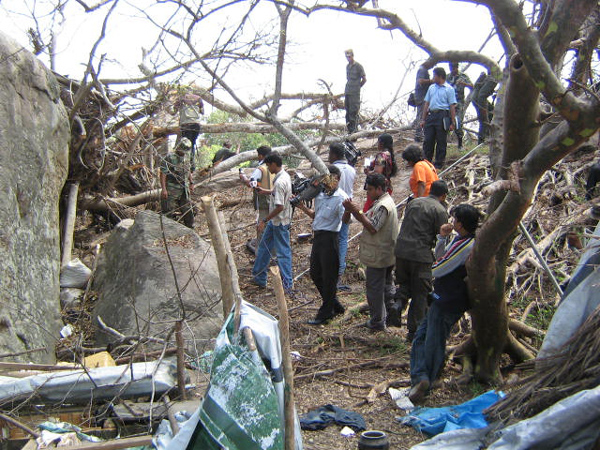
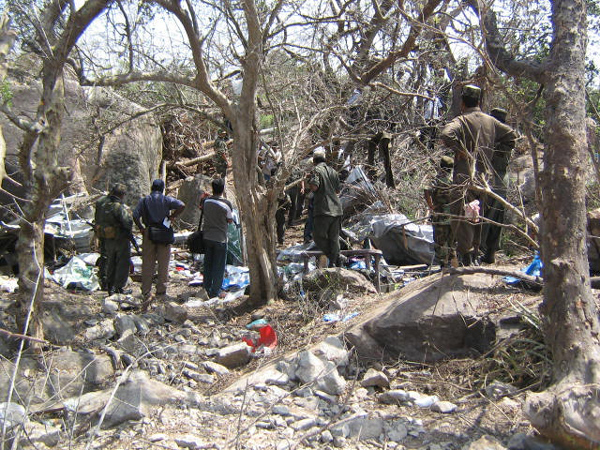

This is what a 1000kg bomb droped could do a terrorist camp.
Has ‘Colonel’ Swarnam been killed or critically injured due to air force bombing ?
The security forces have taken the LTTE-held Vakarai region, wreaking heavy damages to the Tigers, the LTTE seniors appear to be in total disarray with the majority either fleeing the area or refusing to fight the military and waiting in their camps. The Wanni leadership had given orders to a few commanding level Tiger leaders to wait in the region and as a result a handful of seniors still remain in the area.
The latest reports indicate that LTTE’s military leader for Trincomalee ‘Colonel’ Swarnam is either dead or critically injured due to Air Force bombing.
While there is no official confirmation as to what exactly his plight could be, ground sources had confirmed that he was critically injured due to the bombing. The bombardment was carried out by the Air Force early this week following intelligence reports that a large number of LTTE cadres were preparing to launch an attack on the military in the Ichchalampattu area.
Hundreds of LTTE members in Batticaloa and Ampara districts had gathered in Verugal and the precision of the air attacks saw heavy casualties and damages to the LTTE.
Ground troops confirmed that the aerial bombing in the strategic Verugal area – ten miles North - West of Vakarai, from where a big terrorist build-up was reported, had among others killed the personal bodyguard of Swarnam. The same sources claimed that soon after the bombing, all radio communication by Swarnam too had stopped after the attack.
Ever since the fighting broke out in the region a few months ago, the LTTE Leader Velupillai Prabhakaran had ordered Swarnam to lead the military operation against the government security forces.
Exactly a month ago, Wanni Leadership directed the ‘Jeyanthan brigade’ which is tasked with the duty of protecting Vakarai from security forces to recapture what the LTTE has lost to the Army during the past few months.
The brigade had set off from the ‘Sembimale’ camp in Mullaitivu and moved to Vakarai area through Verugal as fishermen.
It is said that they were fully equipped to launch a major attack on the forces under the supervision of Swarnam, who is a close confidante of Prabhakaran.
Around 300-400 cadres have been thus camped in the area and had been collecting information from Kathirweli, Verugal and Vakarai. After the fall of Sampoor, the LTTE leadership was trying his best to get his cadres to hold onto Vakarai since the fall of Vakarai is likely to mark the last days of the LTTE in the Eastern province.
Ever since the fighting broke out in the eastern region, starting from Mawil Aru,the eastern leadership had been sending messages regularly to Wanni asking for assistance in the face of massive ground and air attacks from the government security forces.
It is now confirmed that in order to stop the government’s troops advancing, Swarnam had ordered his cadres to launch artillery attacks towards Sinhala settlements in Somapura and its neighbouring areas. The troops were forced to suspend some of their small operations as a result.
However the reason for the suspension of the main movements towards Vakarai area is something else. That is to ensure the security of some 40,000 still trapped in the LTTE held Vakarai area.
If Swarnam had been killed or even seriously injured, it would be a major setback for the LTTE, not only in the east, but also in the north as well.
Swarnam had led several successful operations against both the government security forces as well as the breakaway Karuna group.
Swarnam, who had led the LTTE’s elite force-Jeyanthan-brigade many a times, was the one who was assigned to kill LTTE’s former Eastern Commander Karuna after his defection.
After a major fight with the Karuna faction in Mavadichenai, north of Verugal, the Northern Tiger platoon led by Swarnam was able to chase the Karuna faction out of the area two years ago and take control of the entire stretch from Sampur to Mankerni.
However, there is no proper command for LTTE in Vakarai area since most of the seniors had left for Vavuniya and Kilinochchi. The LTTE Trincomalee district political leader Elilan and Batticaloa-Ampara Special Commander Banu were among the LTTE leaders who went to the north a few weeks ago after the outbreak of fighting in Vakarai.
Government’s military operations By Thursday evening, government forces were stationed in the strategically important Panichchankerni Bridge of the south of Vakarai, while in the north, troops were consolidating captured areas near the Verugal River.
A few months ago, the government forces launched an attack to capture the LTTE-held Vakarai. Since then LTTE power in the region was dwindling fast.
Right now troops are in full control of Panichchankerni and the nieghbouring areas.
From the north of Verugal, the government forces started advancing towards the south despite heavy resistance from the LTTE.
By yesterday noon military personnel were busy blocking the LTTE movements from all directions. A team from Mahindapura was proceeding towards Verugal area while troops from Threekonamadu were also advancing towards the Tiger held areas in Vakarai.
In Panichchankerni, the troops had reached the bridge.
Tigers had tried to blow up the bridge in order to block the troop movements towards Vakarai. But the military said the LTTE could only make two big holes in the bridge blocking vehicular movements.
Meanwhile another development is that the Karuna group had started hunting down for LTTE cadres fleeing Vakarai to Thoppigala jungle.
The Special Forces who led the operation, yesterday afternoon captured the south of Vakarai.
Monday, January 29, 2007
Two more LTTE camps fall to STF - Kangikadaichi Aru
SL Police Special Task Force personnel continuing on the anti-terror operation "Definite Victory" (Niyathai Jaya) in Ampara district captured two more LTTE camps located inside Kangikadaichi Aru jungle this morning (Tuesday the 30th of January).
The STF sources said that they have found a large food storeroom and a medical unit in the two LTTE camps captured deep inside the woods in Gangamuwa area.
A large stock of medicine and dry foods believed to be donated by INGOs were also found inside the camps. Two double cabs, a van, a mini truck, three motorbikes and few generators are among the other items recovered in the latest phase of the operation.
In September 2006, the STF personnel launched their first anti -terror move in to Ampara district since the signing of 2002 CFA. Since the beginning of last year, the LTTE stepped up violence in Ampara, Thirukkovil, Akkaraipaththuwa, and Bakmitiyawa areas disrupting the normalcy.
The terrorists re-launched their ethnic cleansing campaigns against Sinhalese and Muslim civilians , while the Tamil civilians in Ampara were subjected to a massive recruitment drive that marked with large number of abductions and assassinations.
The STF , the government's only paramilitary has hitherto destroyed 20 odd LTTE strong hold located in the jungles in Ampara district during its operation.
following list of items were recovered at the Medical Center and the food storage captured by the STF personnel during the Operation.
At The Medical Centre
-
Two Double Cabs loaded with medicines
-
Three Motor Cycles
-
A Van (Dolphin)
-
A Double Cab (Nissan)
-
A Tractor
-
A Generator (20Kv)
-
Three Generators (2.5Kv)
-
Ten beds
-
Large quantity of Medicines
-
A Oxygen Cylinder
-
Office Equipments
-
A 21' TV
And at the Storage
-
Fifty two Rice packs
-
Twelve tents
-
Twenty five plastic buckets
(http://www.defence.lk/new.asp?fname=20070130_01)

Friday, January 12, 2007
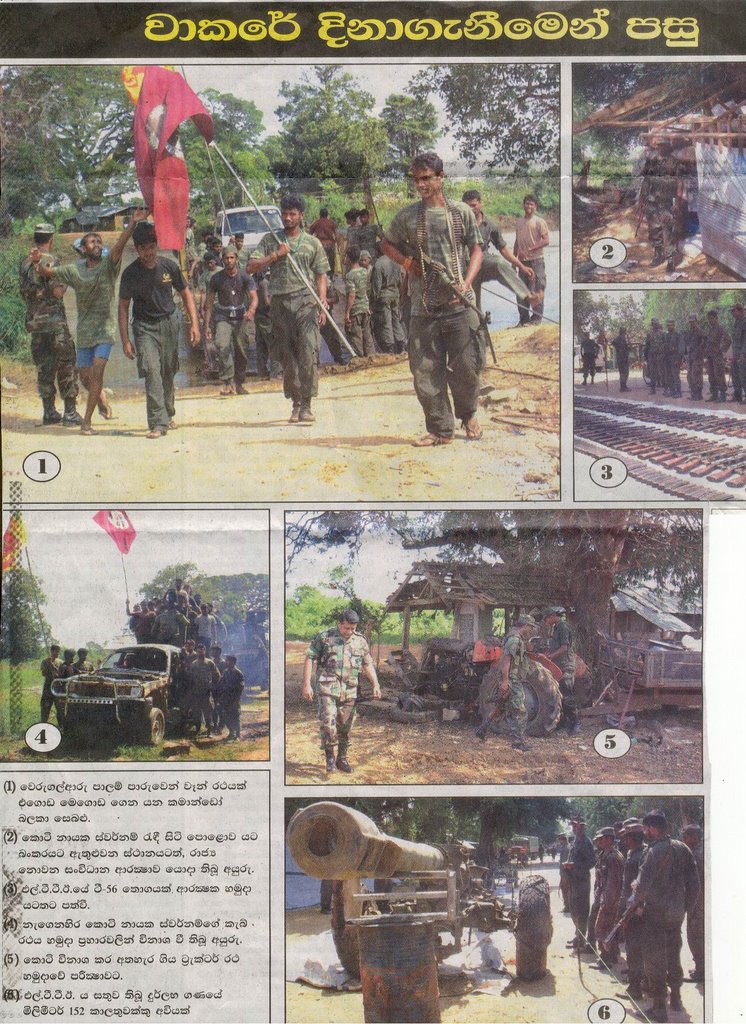
Sri Lankan commandos have taken at least eight Tiger bases
 Sri Lankan commandos have taken at least eight bases used by Tamil Tiger guerrillas to launch attacks in the country's east following an operation lasting several days.(AFP/File/Lakruwan Wanniarachchi)
LTTE Crumbles
January 9, 2007: LTTE defenses continue to crumble, and the organization is regressing back to a terror group, rather than a rebel army. The LTTE is losing control of more territory each day. Suicide bomb attacks are meant to stir up ethnic strife, that will make Tamils angry enough to support the LTTE again. That does not appear to be working, as nearly 600 LTTE fighters have surrendered so far this year.
January 8, 2007: In the east, a major LTTE camp was captured by the army. There, they found a truck loaded with explosives, and rigged to be used as a truck bomb. This was apparently intended for a major attack in the capital.
January 6, 2007: Another LTTE suicide bomber, apparently female, attacked a bus 85 kilometers south of the capital, killing eleven, and wounding up to fifty.
January 5, 2007: An LTTE suicide bomber attacked a bus outside the capital, killing five and wounding nearly fifty others.
January 4, 2007: The army and air force continue their attacks on LTTE targets in the east (where the LTTE is rapidly losing control) and the north (where the LTTE is more powerful.) LTTE losses for December were some 2,200 killed, and many more wounded. LTTE is having a hard time recruiting new people, and has been relying more on coercion. This, however, produces troops of uncertain quality.
(http://www.strategypage.com/qnd/srilank/articles/20070109.aspx)
ZOA - a Dutch Protestant Agency is suspected of running hospital inside LTTE camp in Amparai in East Sri Lanka
Sri Lanka Defense spokesman Minister Keheliya Rambukwella said that the Netherlands based ZOA; a non-governmental organization registered for refugee care was suspected of running a hospital at a Tamil Tiger insurgent garrison overrun by the country’s elite police commandos, the Special Task Force (STF) recently.
ZOA Refugee Care is an international and Protestant agency, based in the Netherlands, and focuses on relief and rehabilitation among refugees and IDPs. In the beginning ZOA worked in countries in South East Asia. ZOA is the abbreviation in Dutch for Zuid (South) Oost (East) Azie (Asia), the part of the world where ZOA started her work in the seventies.
The Minister said, "We found an NGO fully and totally involved in running a hospital at Stanley Base. It is ZOA."
Stanley Base, one of the largest Liberation Tigers of Tamil Eelam (LTTE) garrisons in the Eastern Province jungles of Ampara, was overrun by the STF recently and the Defense sources revealed that a NGO who are supposed to care for civilians were actually running a hospital for the guerillas inside the garrison where no civilians were allowed to enter.
But ZOA has announced that the equipment found in the Tiger hospital might have been stolen from their closed down office.
Immediately after the LTTE’s Stanley camp, named after its commander, was abandoned by the Tamil Tigers, the STF said they were amazed to discover the hospital run by the Dutch NGO.
If the NGO is found guilty after a full investigation ZOA will be ordered to leave the country, Rambukwella said.
Rambukwella said certain other groups are also under investigation for helping the LTTE insurgency. But he did not name them.
"Certain NGOs are acting against the normal law of the land and have got involved with subversives. Some have stooped down to assisting the terrorists.”
"Once investigations are over and we have 100 percent confirmation of what we suspect ... we will have to take steps to have their visas revoked or order them to leave," Rambukwella further said, referring to ZOA.
However, ZOA's general affairs manager, Anslem Mudiatta, has denied the charge He told a news agency: "The allegation is of course groundless.”
"We ... closed our office because of fighting and had to leave so many things behind which we couldn't carry with us," he added. "Certain things they say were found in that LTTE (Tiger) hospital is things we presume were taken from our office."
In a second incident January 11, the STF commandos overran another Tiger camp at Kanjikudichchi Aru named Janak in Ampara and found two boats donated by Save the Children and two tents emblazoned with the UN refugee agency UNHCR's logo, officials said.
But defense officials were of the opinion that, in this case, the aid had been stolen from civilians it was donated to by the LTTE.
(http://www.asiantribune.com/index.php?q=node/4103)
ZOA - a Dutch Protestant Agency is suspected of running hospital inside LTTE camp in Amparai in East Sri Lanka By Walter Jayawardhana
Sri Lanka Defense spokesman Minister Keheliya Rambukwella said that the Netherlands based ZOA; a non-governmental organization registered for refugee care was suspected of running a hospital at a Tamil Tiger insurgent garrison overrun by the country’s elite police commandos, the Special Task Force (STF) recently.
ZOA Refugee Care is an international and Protestant agency, based in the Netherlands, and focuses on relief and rehabilitation among refugees and IDPs. In the beginning ZOA worked in countries in South East Asia. ZOA is the abbreviation in Dutch for Zuid (South) Oost (East) Azie (Asia), the part of the world where ZOA started her work in the seventies.
The Minister said, "We found an NGO fully and totally involved in running a hospital at Stanley Base. It is ZOA."
Stanley Base, one of the largest Liberation Tigers of Tamil Eelam (LTTE) garrisons in the Eastern Province jungles of Ampara, was overrun by the STF recently and the Defense sources revealed that a NGO who are supposed to care for civilians were actually running a hospital for the guerillas inside the garrison where no civilians were allowed to enter.
But ZOA has announced that the equipment found in the Tiger hospital might have been stolen from their closed down office.
Immediately after the LTTE’s Stanley camp, named after its commander, was abandoned by the Tamil Tigers, the STF said they were amazed to discover the hospital run by the Dutch NGO.
If the NGO is found guilty after a full investigation ZOA will be ordered to leave the country, Rambukwella said.
Rambukwella said certain other groups are also under investigation for helping the LTTE insurgency. But he did not name them.
"Certain NGOs are acting against the normal law of the land and have got involved with subversives. Some have stooped down to assisting the terrorists.”
"Once investigations are over and we have 100 percent confirmation of what we suspect ... we will have to take steps to have their visas revoked or order them to leave," Rambukwella further said, referring to ZOA.
However, ZOA's general affairs manager, Anslem Mudiatta, has denied the charge He told a news agency: "The allegation is of course groundless.”
"We ... closed our office because of fighting and had to leave so many things behind which we couldn't carry with us," he added. "Certain things they say were found in that LTTE (Tiger) hospital is things we presume were taken from our office."
In a second incident January 11, the STF commandos overran another Tiger camp at Kanjikudichchi Aru named Janak in Ampara and found two boats donated by Save the Children and two tents emblazoned with the UN refugee agency UNHCR's logo, officials said.
But defense officials were of the opinion that, in this case, the aid had been stolen from civilians it was donated to by the LTTE.
(http://www.asiantribune.com/index.php?q=node/4103)
Tamil Tigers in a death groan in the East of Sri Lanka, after the STF capture of Janak Camp in Amparai
Liberation Tigers of Tamil Eelam is in a ‘death groan’ and counting their days in the restive East of Sri Lanka, when they lost one more camp in the Amparai district yesterday to the Sri Lanka Police Special Task Force.
The Police Special Task Force (STF) wrested the control of LTTE’s 'Janak’ camp, situated west of the earlier captured ‘Stanley camp' in Kanchikudichcharu in the Ampara district.
The Stanley camp was the biggest base in the Amparai district. Loss of Stanley base and the Janak camp is a huge draw back of the Tigers stronghold in the Eastern province, security sources said.
Initially, LTTE cadres fired mortars from the 'Janak' camp at STF personnel deployed around the "Stanley Base" which was captured by the STF on Monday 08 January, according to the military sources.
In the battle that ensued, STF on Wednesday morning captured LTTE’s camp called 'Janak' and six other small camps in Kanchjudichcharu, Ampara, killing four LTTE cadres. Two STF personnel sustained minor injuries, a military source said.
The capture of ‘Stanley’ and ‘Janak’ camps is a strategic victory that would eliminate the terrorist threat posed to Security Forces camps in the East, said Military spokesman Brigadier Prasad Samarasinghe .
According to Media Centre for National Security the STF personnel have found in the captured Janak camp, a considerable stock of STF like uniforms and another stock of STF camouflage cloths and Army camouflage cloths and ten sewing machines – indicating the presence of a LTTE apparel factory.
In addition, the stock includes a sniper with night vision, a single eye night vision sniper, one HK LMG and a ‘Gamin’ Global Positioning System. Three trail bikes, one 15KVA Generator were also in the list of items recovered.
Two boats with name and logo of the Non Governmental Organization ‘Save the Children’ and two tents with the logo of UNHCR were also recovered from the site.
(http://www.asiantribune.com/index.php?q=node/4102)
Sri Lanka 2006: LTTE’s unbalanced score card by Col R Hariharan (retd.)
The year 2006 may be called the year of reckoning for LTTE. What LTTE had been sowing during the four years of ceasefire from 2002 came back to haunt it in 2006. It was also a year that saw LTTE reaching the point of abandoning the East to Karuna’s control. The year also saw the international community, already tired of LTTE’s old rhetoric, got increasingly disenchanted with LTTE’s methods. This enabled the Sri Lanka President Rajapaksa, who was elected thanks to LTTE’s ‘advisory’ to Tamils to boycott the elections, to turn the peace process into a military dialogue, even as the international community watched on the sidelines.
With the rise of Sinhala chauvinism, the danger of the war against LTTE turning into a war against Tamils has approached near reality. The reincarnation of the modified version of Prevention of Terrorism Act and the de-merger are the other fallouts of the weakened equation LTTE had arrived at with the Government towards the end of 2006. For an organization that spoke of peace with a military superiority in 2002, it is a steep decline.
The ceasefire year 2006 also had the unsavory distinction of about 3500 people of all ethnic groups losing their lives. That included over 1000 LTTE men, women and children.
And all this has cost the Tamil civilians dearly because they formed the bulk of the 215,000 internally displaced people who fled the war zones. Over 16,000 of them sold everything they possessed to seek safety in Tamil Nadu. At least a thousand of them were killed, their lives cut short by the war.
LTTE’s efforts to push India to pressurise Government of Sri Lanka, without uttering even a word of regret for its misdeeds in India, as expected, did not yield any worthwhile results except more statements from Indian politicians.
LTTE score card 2006
To those who do not subscribe to LTTE methodology, LTTE’s overall goal appears murky. LTTE appears to be trying hard to push the clock back to 2001, after shedding the blood of at least 3,000 of its own kind in the years of peace, and complaining to the international community when the fortunes of war went awry. The bottom line is that LTTE strategies of 1996 and 2000-2001 are not working in 2006 as international ambience has changed. In a nutshell the only achievement of ceasefire period appears to be that LTTE had sacrificed the international sympathy the Tamil cause had enjoyed all these years, to crown itself as the sole spokesman for Tamils in Sri Lanka.
Of course there were other ‘gains’ of earlier years that lost their shine in 2006:
• Assertion of territorial legitimacy: LTTE has created an administrative structure, including police and judiciary, to run the civil administration in the areas under its control. This has buttressed LTTE’s claim of running a de facto state as part of its quest to gain legitimacy. From the early stages of ceasefire it sought to gain recognition of parity with the Sri Lanka state and demanded the right for freedom for Sea Tiger boats to move in Sri Lanka waters. However the SLMM curbed such moves when LTTE misused this freedom to launch operations against Sri Lanka Navy in 2005-2006. But LTTE does not appear to have given up its quest for legitimacy. Armed Sea Tigers seized a Jordanian ship MV Farah III, carrying 14000 tons of rice, which was stranded 8 nautical miles off Mullaitivu due to engine trouble on December 23, 2006. They arrested the 14- member Arab crew and whisked them away to Kilinochi. According the ship’s captain, Sea Tigers also confiscated the ship’s communication equipment and computers. In international terms, this action is called piracy. If LTTE wanted to reassert its claim to legitimacy in 2006, it could not have chosen a worse way of articulating it.
• Elimination of Military Intelligence assets: During the first two years of peace, LTTE had systematically hunted down operatives of Military Intelligence. These MI assets built over the years had enabled the Security Forces to conduct successful deep penetration operations inside LTTE controlled territory. LTTE’s victims included PLOTE Mohan and ten other MI agents, MI unit commander Major Nazim Mutaliph, and Inspector Jeyaratnam. LTTE also targeted senior military officers in 2005-2006. Though it failed in its attempt on the Army Commander Lt General Sarath Fonseka, it managed to kill Major General Parami Kulatunge, Deputy Chief of Staff, further aggravating the military situation. The net result was the Sri Lanka Army gained a handle to pound the LTTE positions relentlessly by both air and artillery fire.
• Occupation of strategic pockets: In the North, LTTE carried out sporadic guerilla actions to prevent the free movement of troops even in areas outside LTTE control. However, the strong military response from Sri Lanka Security Forces in 2006 reduced LTTE to be totally defensive. Now LTTE has started attacking soft civilian targets in Sinhala predominant areas and a feeling of déjà vu is unfolding. Unlike the North, in the East clearly demarcated forward defended lines do not exist. Over the years LTTE took advantage of this to establish its presence in areas like Sampur, Mutur East and Mavil Aru to interfere with naval operations and dominate the operation of Trincomalee harbor. In 2006, Security Forces evicted the LTTE from these areas and confined it to a small pocket in Vakarai after a series of military operations. Tamils driven from their homes in this region due to these operations are still stranded. And the risk of these Tamils losing their ‘traditional homeland’ forever in the East is real now.
• Recruitment and training of fresh cadres: According to UNICEF, as on Apr 30, 2006 LTTE still had 1440 children recruited since ceasefire (859 of them now 18 years or above). These children were apparently retained out of the total 5375 children LTTE had recruited since the ceasefire. Despite LTTE’s efforts at damage control, internationally LTTE has gained the dubious recognition as one of the front line child recruiters in 2006. No amount of finger pointing at the Sri Lanka Security Forces, which was also named for helping Karuna in such recruitment, is going to absolve LTTE.
• Sea Tiger actions: LTTE carried out a number of successful Sea Tiger operations during 2005. But during 2006, the revamped Sri Lanka military leadership ensured that most of such attacks were either neutralised or compromised even before they were launched. This raises a question mark on the much-vaunted organisational secrecy of LTTE, if not the operational competency of Sea Tigers in dominating the coastal seas.
• LTTE’s international support network: LTTE had used the first two years of ceasefire to build ‘legitimate’ relations with European nations. This helped its international support network to operate without interference, as the Government of Sri Lanka wanted to play down such demonstrations of ‘functional autonomy.’ But after walking out of the peace process, LTTE arrogated the right to kill not only military targets but also innocent civilians in scores, even while talking of peace. Such killings and perhaps the assassination of Foreign Minister Kadirgamar in a way, made the EU re-examine its relationship with LTTE. The EU ban on LTTE came a little later after advance notices of caution.
The Human Rights Watch published a well-documented report on extortions carried out by LTTE in Canada in March 2006. And the new political leadership in Canada slapped a ban on LTTE. Two Tamil social organizations, known for their pro-LTTE leanings in Canada are under investigation for various illegal actions in support of LTTE. The UK, the traditional tolerant home of LTTE, had to intervene when LTTE inveigled into the Wanni two of its erstwhile benefactors, Rajasingham Jeyadevan and AK Vivekananthan and held them captive in a bid to seize control of a prosperous Hindu temple in Britain. Already the Tamil Rehabilitation Organisation (TRO) was under investigation in Britain. The long arm of law in Britain started devoting its unwelcome attention on LTTE activities in the UK since then. And the story continues. As a result of all these events, LTTE’s international supporters among Tamil Diaspora have become less vocal, particularly when LTTE needs their full-throated support.
• LTTE arms procurement: LTTE is reported to have imported at least 12 shiploads of arms during the ceasefire period. It was able to upgrade its artillery, anti-tank and small arms to improve its firepower with these imports. (According to the Sri Lanka Army Commander Lt General Fonseka, LTTE managed to increase its holdings of 122 MM guns from 20 to 100 through such imports.)
However, in 2006 there were major setbacks to LTTE’s arms procurement. In a sting operation in August 2006, FBI arrested 13 Sri Lankan ethnic Tamils domiciled in the U.S. and Canada for multiple crimes connected with LTTE. The crimes included attempting to purchase illegal arms from FBI agents posing as arms dealers on Long Island, USA, attempting to obtain classified information, conspiring to bribe U.S. public officials in an effort to remove the LTTE from the U.S. State Department’s list of Foreign Terrorist Organizations, and dealing in illegal financial transactions with the LTTE. The wish-list of arms included up to 100 Russian-made SA-18 shoulder-fired, surface-to-air missiles, 500 AK-47 assault rifles and other weapons. According to the FBI agents, those arrested were seeking missiles capable of shooting down Sri Lanka Air Force’s Kfir fighter jets. In another operation FBI arrested six persons including four Tamils and two Indonesians in Guam in October 2006 when they deposited $ 700,000 with undercover agents in Maryland as a down payment for millions of dollars worth of missiles, sniper rifles, submachine guns and grenade launchers for LTTE. The Government of Sri Lanka made special efforts to persuade Cambodia, Indonesia and Thailand to tighten their controls to prevent such sales to LTTE. Overall, the coming years are going to be tough for LTTE to buy and transport arms as before due to the tightening of international maritime anti terror controls now in force. Protocols like the United Nations Convention on the Law of the Sea (UNCLOS), Automatic Identification System (AIS) cargo requirements and the International Ship and Port Facility Security Initiative (ISPS) code have been introduced which make maritime traffic more accountable.
• Erosion of Norway’s mediation efforts: Norway had been enjoying close relationship with LTTE all along. LTTE had not hesitated to leverage this relationship, particularly the personal rapport that existed by the Norwegian peace envoy and minister Erik Solheim and the late Anton Balasingham, Prabhakaran’s political advisor, to its advantage. Despite this, during the year 2006 LTTE has practically neutralized the Norwegian peace effort by making it difficult for Sri Lanka Monitoring Mission (SLMM) to effectively operate after the EU banned LTTE. This has made it convenient for Sri Lanka Security Forces to launch military actions, even if they contravened the terms of the Ceasefire Agreement without any inhibitions. Norway pulling out of the mediation process at least for a while appears a distinct possibility.
Lack of credibility
The LTTE is perhaps the strongest non-state actor with military capability in Asia. Its falling fortunes in 2006 can be attributed to certain characteristics of Prabhakaran’s leadership conduct of LTTE. These have eroded the organization’s credibility:
• Prabhakaran has been able to conduct LTTE’s military operations with considerable thought to strategy. However, in political decision-making he seems to lack the flexibility of thought and pragmatism of approach. Due to this weakness a number of impulsive political decisions he had taken have created long term problems for the organization. The killing of Kadirgamar and the boycott of Presidential poll 2005 are such recent decisions that have adversely impacted LTTE fortunes.
• The monolithic and egocentric leadership of LTTE under Prabhakaran does not encourage free exchange of ideas. As a result a second line leadership has not bloomed. In handling the peace process, this has created problems in dealing with other countries, particularly while dealing with the Government of Sri Lanka, which operates with a well-oiled bureaucracy. This problem is likely to be aggravated by the recent death of Anton Balasingham.
• Prabhakaran’s abiding faith in the gun exhibited so readily even during the ceasefire period, particularly to get political and military leaders eliminated, has increased the hiatus between what LTTE says and what it does. Thus LTTE has not been able to carry its message with credibility in the international media.
• Over the years LTTE has gained the reputation as anti-intellectual body, thanks to its systematic and often mindless elimination of Tamil intellectuals. Any such killing is now generally attributed to the LTTE, whatever LTTE may say. The assassination of Ketheshwaran in 2006, the latest in such killings has been internationally condemned and the adverse fallout has naturally come on LTTE. As a result Tamil intellectuals, who share the same national self-determination vision for Tamils as LTTE, have been reluctant to actively join the struggle under the flag of LTTE.
• LTTE’s conduct in utter disregard to international norms on human rights and humanitarian laws has come under severe criticism of international watchdog bodies and the UN. These relate to a large number of issues including child recruitment, illegal arrests, kidnapping etc., apart from assassinations and suicide bombings. The international criticism of LTTE peaked in the year 2006.
• Prabhakaran has never shown any hesitation in eliminating those whom he considers as obstruction to his objectives regardless of his personal relationship with them. At the same time whenever the LTTE’s political or military interests demanded, Prabhakaran had shown no hesitation even to sup with the enemy. Even as the IPKF was fighting with LTTE, and a political lobby in India was actively working to end the war, he opened a line for rapprochement with the Sri Lanka President Premadasa in 1989. After Premadasa managed to send the Indian troops out of Sri Lanka and eased the pressure on LTTE, Prabhakaran walked out on Premadasa. And Premadasa’s life ended the way former Indian Prime Minister Rajiv Gandhi’s at the hands of a suicide bomber.
Given this background, it is difficult to predict how LTTE would behave in the year 2007. Undoubtedly, it is going to be more difficult than 2006, not only for LTTE but also for Sri Lanka as well, as conventional operations heat up. However, LTTE is not an organisation to be cowed down by fear of failure. It has shown great resilience in the past to bounce back. But when conventional operations threaten its existence, LTTE could expand and extend its unconventional terrorist operations in Sri Lanka.
With the Norwegian mediation no more effective, Sri Lanka could be heading to an outburst of terrorist violence. Perhaps, the two explosions in public transport buses that killed 21 civilians in Galle and Gampaha districts in the first week of the New Year were signals of things to come. LTTE’s political wing leader SP Tamilselvan earlier in the week had warned of severe repercussions after Air Force bombed a settlement in Mannar killing 14 persons. Bishop of Mannar has confirmed with his own eyewitness account that those killed were civilians including children and not LTTE cadres of a Naval Base. It is to the credit of the people of Sri Lanka, than political leaders, that they have maintained ethnic harmony despite sustained grave provocations from all sides. If more and more acts of violence and retributions are carried out the limits of tolerance of ethnic communities may well be broken.
The lack of credibility in LTTE makes it difficult for countries like India or the UK where Sri Lanka Tamils enjoy considerable goodwill, to take any initiative on their own to bring back peace in the Island. LTTE’s military initiatives afresh are not going to dramatically improve either its fortunes or lead to a lasting solution. Fortunately for LTTE, in the Tamil National Alliance (TNA) there a number of experienced Tamil politicians who have considerable knowledge and experience in handling political initiatives. It is high time Prabhakaran used their talent positively, not only to his advantage but also to the advantage of Tamils at large. And that can come through only through lasting peace. Will Prabhakaran take such an initiative in the interest of the people?
Of course the rising Sinhala chauvinism and the Sri Lanka State and polity also have an equal share in the ongoing dismantling of the peace process. And that is altogether another theme to analyse.
Col R Hariharan, a retired Military Intelligence specialist on South Asia, served with the Indian Peace Keeping Force in Sri Lanka (1987-1990) as Head of Intelligence.
(http://www.asiantribune.com/index.php?q=node/4100)
Sri Lanka rebels suffer fresh setback, lose control of a major camp in Amparai
The LTTE has suffered yet another major setback, after losing control of a major (LTTE) camp in the Eastern province on Monday afternoon, the media centre for national security told the Asian Tribune.
The camp named 'Stanley' situated in Amparai's Kanjikudichcharu was often used by the Tamil Tiger rebels to attack security forces. The camp was also reportedly a training base for the rebel's under age recruits who underwent arms training there.
"The camp came under security forces control by 2.00 Monday afternoon. The entire operation was carried out by the police Special Task Force unit," a centre spokesman said.
The rebels who were present at the camp at the time of the operation reportedly fled the camp leaving behind all their belongings as they were unable to defend themselves successfully.
On a subsequent search operation, the special task force had recovered a large cache of explosives, arms/ammunition and anti-personnel mines.
"In addition to the Stanley camp, the STF personnel have found a fully equipped hospital funded by an INGO, a warehouse filled with dry rations meant for civilians, 2 sub-camps, an intelligence camp, a circuit bungalow and a cafeteria, abandoned by the fleeing tigers.
STF had also found a water bowser donated by the Tamil Rehabilitation Organization (TRO), 3 motor cycles, Generators, satellite antennas and coffins," the centre said.
Three security personnel who sustained injured during the operation was rushed to the Ampara hospital.
(http://www.asiantribune.com/index.php?q=node/4062)
Thursday, January 11, 2007
A Police Special Task Force (STF) Commando gestures during a tactical operations demonstration
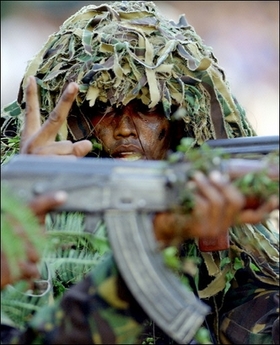 A Sri Lankan Police Special Task Force (STF) Commando gestures during a tactical operations demonstration at a passing out parade in Katukurunda, some 43kms south of Colombo, 28 December 2006. Some 313 recruits concluded their STF training at the training centre in Kalutara. The nucleus of the STF the para-military arm of the country's police force was formed in 1983, drawing on policemen already in service and having them trained by the Army in the handling of infantry weapons and given basic training in "jungle operations", and who are deployed essentially for counter terrorist and counter insurgency operations within the country and also undertake close protection duties.
Special Task Force Commandos travel by military jeep in Ampara

Special Task Force soldiers travel by military jeep in Ampara, Sri Lanka January 1, 2007. A soldier was killed and another two were injured when suspected Tamil rebels detonated a claymore mine targeting security forces personnel, the defence ministry said. REUTERS/Stringer (SRI LANKA)
STF captures another Tiger camp: military
The Special Task Force yesterday captured another LTTE camp in Kanchikudichchiaru in Ampara killing at least 4 rebel cadres and recovering several boats and tents donated by two world organisations, the military spokesman said.
Two STF personnel were injured in the battle.
“Elite forces personnel recovered boats and tents donated by Save the Children and UNHCR from the newly captured LTTE 'Janaka' base in Kanchikudichcharu,” spokesman Prasad Samarasinghe claimed.
He said the two boats had ‘Save the Children’ marked on them and believed the LTTE had been forcibly taking over tsunami aid donated by NGOs to affected people.
The troops also captured a large factory inside the ‘Janaka’ camp where uniforms were stitched for LTTE cadres, he said.
The military spokesman said several military items including weapons and ammunition, motor cycles and other vehicles had also been recovered from within the camp.
Among the other items recovered were a generator (15 Kw), 10 sewing machines, one Global Positioning System (GPS), STF uniforms, one roll of STF camouflage material, a stock of Army Ranaviru apparel camouflage material, one night vision sniper rifle, one monocular night vision device and a light machine gun (LMG).
The STF gained control of seven sub-camps of the Tigers in the vicinity of the newly overrun ‘Janaka’ camp and confirmed that one of the camps captured was meant for female cadres.
LTTE cadres had launched mortar attacks from the ‘Janaka’ camp at STF personnel deployed around the ‘Stanley Base’ which fell to the forces on Monday.
A fully equipped hospital known as ‘Thileepan’ situated inside the Stanley Base was discovered.
The military claimed the ‘Thileepan’ hospital had been built by a Netherlands based NGO identified as ZOA. The NGO had also built some 500 houses utilising tsunami aid to LTTE mahaveera families in the Kanchikudichicharu forest area.
(http://www.dailymirror.lk/2007/01/12/front/04.asp)
Rebel's camp captured in Sri Lanka's east
Sri Lanka's elite police captured a major camp of the Tamil Tiger rebels in the east on Thursday and killed at least four rebels in the action, said the military.
The Special Task Force (STF) of the police seized the Janak camp of the Liberation Tigers of Tamil Eelam (LTTE) in the Ampara district in the morning and two STF personnel were injured in the confrontation, said the Media Center for National Security in a statement.
According to the statement, the Janak camp is situated west of the recently overrun Stanly base, the LTTE's biggest camp in the Ampara district.
"The capture of LTTE's Stanly and the Janak camps is a strategic step forward in eliminating the terrorist threat on security forces camps in the east," said the statement.
The STF said a large factory where uniforms were stitched for LTTE cadres had been situated inside the Janak camp. Mortar cycles and other vehicles had also been recovered from within the camp.
Sri Lanka's Army Chief Sarath Fonseka said earlier that the military was determined to liberate the east from the LTTE and later focus on the north.
Conflict between the government troops and the LTTE has been escalating since December 2005, with more than 3800 people being killed.
The Norwegian backed peace process and the truce agreement signed between the two parties in 2002 are currently stalled as a result of the violence.
(http://english.people.com.cn/200701/11/print20070111_340346.html)
The Special Task Force (STF) of the police seized the Janak camp of the Liberation Tigers of Tamil Eelam (LTTE) in the Ampara district in the morning and two STF personnel were injured in the confrontation, said the Media Center for National Security in a statement.
According to the statement, the Janak camp is situated west of the recently overrun Stanly base, the LTTE's biggest camp in the Ampara district.
"The capture of LTTE's Stanly and the Janak camps is a strategic step forward in eliminating the terrorist threat on security forces camps in the east," said the statement.
The STF said a large factory where uniforms were stitched for LTTE cadres had been situated inside the Janak camp. Mortar cycles and other vehicles had also been recovered from within the camp.
Sri Lanka's Army Chief Sarath Fonseka said earlier that the military was determined to liberate the east from the LTTE and later focus on the north.
Conflict between the government troops and the LTTE has been escalating since December 2005, with more than 3800 people being killed.
The Norwegian backed peace process and the truce agreement signed between the two parties in 2002 are currently stalled as a result of the violence.
(http://english.people.com.cn/200701/11/print20070111_340346.html)
STF captures another Tiger camp with a garment factory in Eastern Sri Lanka
Elite Sri Lankan Special Task Force (STF) captured another LTTE camp in Kanchijudichcharu in the Ampara district killing at least four Tiger terrorists this morning, military said.
They said that STF personnel who captured LTTE’s Ampara district main camp known as Stanley Base in Kanchijudichcharu last Monday (08), captured the ‘Janaka’ camp, situated west of the Stanley Base.
LTTE cadres had launched mortar attacks from the 'Janaka' camp at STF personnel deployed around the Stanley Base.
According to the STF, a large factory where uniforms were stitched for LTTE cadres had been situated inside the Janaka camp. Motorcycles and other vehicles had also been recovered from the camp.
(http://www.colombopage.com/archive_07/January11125043JV.html)
Subscribe to:
Posts (Atom)