Thursday, July 07, 2005

Who’s gunning for the SL forces; besides the Tigers?

The military propaganda of any army maintained by a sovereign State is considered a primary responsibility of the State.

Starting from the United States to India from Russia to Pakistan, keeping the morale of the army, be it in times of war, truce or peace, is considered a high priority.

Just as much as wars are fought in the battlefield, similar wars are waged on the internet with the governments fighting its web battles with rebels in Kashmir, Chechniya, Iraq and groups like Basques, IRA and even Al Qaeda.

This type of counter-propaganda by the governments is considered as an integral part of State military strategy, since powerful propaganda machines of the rebels work round the clock, often presenting a distorted picture of what exactly is going on.

That the Liberation Tigers of Tamil Eelam has one of the most effective global media networks is a fact.

It is also true that the pro-Tiger media, more often than not, twist news, cover up LTTE human rights violations and project the Sri Lankan security forces as nothing less than Hitler’s Nazi army.

Still there is very little that has been done by successive governments since the break out of the 1983 war to correct the records and counter LTTE propaganda internationally, especially when it comes to making use of information technology.

While the nationalist parties and groups complement whatever media campaigns by the governments elsewhere, even that had not been done in an effective and organized manner here.

This imbalance in the volume of military propaganda had always been to the disadvantage to the consecutive governments and especially the security forces.

If this has been bad, a worse trend has been set since the truce – that is in the form of depriving the military of their due, accepted share in the government media.

What the country has been witnessing since February 2002 is a dilemma of the State media as to how they should react to LTTE ceasefire violations and other violent activities.

The penchant has been that whenever there are gestures of goodwill by the LTTE the state media would play down Tiger violations and expose those in times of hostile vibes.

Besides, with part of the media parading as independent, the security forces of Sri Lanka, have found that there is only a handful of groups to present their side of the story even to the local audience. In no way a match for the Tiger propaganda.

The rebels on the other hand, true to its style, had been religiously adhering to one single stand in their media campaigns, be it during war or peace – to ruin the reputation of the government forces.

The effectiveness of the LTTE campaigns is such that even the southern media organizations, more often than not, borrow reports from the Tiger media with ‘exclusive’ Tiger versions, in the mad rush to meet deadlines.

The result –a growing disillusionment among the security forces of the manner in which incidents are presented in the media.

Last Saturday, nearly eighty LTTE cadres were escorted from Black Bridge in Batticaloa to Omanthai by the Sri Lanka Army. That was barely 48 hours after the Tigers gunned down three soldiers attached to the intelligence unit of the 223 Brigade Headquarters.

Hours after the grave ceasefire violation, the country witnessed how LTTE Political Wing Chief S.P. Thamilselvan demanded escort for their cadres with a two-week deadline.

His deadline has been given serious thought while the murders of the three soldiers have already gone down history as ‘just another” violation of the ceasefire. This tragedy of the army was overshadowed by political theatrics, including debates on P-TOMS, public rallies and extravagant birthday bashes.

One hardly hears a word these days from government quarters about the broad daylight murder of Major Muthalif in the heart of Colombo in the run up to the P-TOMS.

Just talk to a military personnel – an officer or a soldier - and ask how they feel about the developments. One could gauge the frustrations of our security forces in an honest answer.For them it is not a question about saving their own lives, thanks to the truce – but more about the dignity of the forces and the territorial integrity.

The military top brass and the retired flag-ranking officers attribute the developments to a couple of key factors.

First, the total ignorance of the seniors of the governments as to how they should handle the media in times of a ceasefire.The officers are of the opinion that the leaders of the principal parties should study cases where State or public media was handled during ceasefires in other countries. While there needs to be a change in the tone of reporting, a truce does not at all mean a drastic scale down of military propaganda, they argue, especially when the rival group is as powerful as the Liberation Tigers of Tamil Eelam.

The second factor is a group of obnoxious anti-SL security forces lobby, mainly comprised of a handful of NGOs and INGOs.

And unlike the JVP which just scratches the surface when it talks of an anti-State NGO infiltration of the government, the military is armed with enough evidence to prove this point.

Especially the Sri Lanka Army is of the opinion that there is a concerted effort by this lobby to weaken the military morale and block any moves by the State to strengthen the military capabilities, and they cite many instances to prove this.

Generally identified as sympathizers of the LTTE, this lobby, the senior officers argue, is almost having coercive powers over several leading figures in the government and the main opposition.

In no other country, many observe, would the State have allowed anti-government forces to infiltrate the State machinery in this manner.

And where this reading of the political and military developments would lead to, is the question.

The third group that contributes to the undermining of the government security forces, they claim, is a section of the media which carries out agendas of political parties which are intrinsically prejudiced against the government forces.

How and why they are doing that, the military points out, is public knowledge.

It is already on record that the government forces are of the opinion that several clauses of the ceasefire agreement compromised their security concerns. And it goes without saying that if the tri-services were properly consulted, the P-TOMS would never have seen the light of day as it is.

The decision to let the LTTE engage in “political work” in government-controlled areas as per Article 1.13 of the Ceasefire Agreement, while barring any movement by the security forces or the Tamil parties other than the LTTE in Tiger territory, had always been seen as a tilt in favour of the LTTE.

Article 1.2 of the Ceasefire Agreement bans “firing of direct and indirect weapons, armed raids, ambushes, assassinations, abductions, destruction of civil or military property, sabotage, suicide missions and activities by deep-penetration units”.

All these banned activities, including suicide attacks, have been carried out by the LTTE so far.

The military is of the opinion that despite the high incidences of violations, the Tigers have managed to get away with minimum publicity for their mischief, and they ascribe this to the success of the anti-SL forces lobby. These, they claim, are in the form of re-wording or sugarcoating of government responses to Tiger truce violations.

As for the P-TOMS, it is viewed as a part of a political agenda to woo the international community rather than one executed with any genuine concern for the tsunami-affected.

They observe that minimum regard had been paid to the security implications in the over-enthusiasm to rope the Tigers into a deal by those who were following an outright political agenda.

Once again the anti-SL security forces lobby is being implicated for working on several high-ranking and secondary level counsellors to make sure that the deal got off the ground despite the grave security implications it poses.

It is true that pursuing an all-out military agenda would make it impossible for any government to make headway towards peace. A healthy equilibrium has to be struck between security and political agendas if one is to make progressive moves towards reaching a negotiated settlement to any conflict.

However, there is growing consensus that what had been done in the name of peace by the principal parties is jeopardizing the most crucial security concerns of the State.

And there is a steady build-up of frustration within the military ranks over this state of affairs.

While the government can dismiss the rhetoric of the nationalist parties as slogan politics, it cannot do the same with the concerns of the military.

Initiating a dialogue with the security forces, at all levels, is a must for the government, before it is too late.

(http://www.dailymirror.lk/2005/07/06/opinion/1.asp)

Thursday, June 23, 2005

SLMM hushes up abduction of van driver by LTTE

Colombo, 21 June, (Asiantribune.com) The family of a Sinhalese van driver who was abducted by the LTTE went to the Sri Lanka Monitoring Mission (SLMM) to complain. SLMM told them to keep quiet and not to tell the Police. So they didn’t tell the Police.

But they went to the Red Cross in Vavuniya. A man named Anton was in charge and he did not take down the complaint. He told them to come back in two days time.

This is only one part of the story of 32-year-old H. K. C. Abeysekara, National ID 693573254v of Ruwanpura, Kirigalwewa, Medawachchiya. He is a father of two children: son Poorna Deshan Abeysekara(6 )and Dulanjalee Abeysekara (3) His wife Nirmala Dissanayaka 26 yrs.

His job was to drive the Toyota van 51-8464 owned by a Tamil mudalali. He promised to get the Sinhala driver out within two days. Even he is absconding now. The LTTE suspects that the driver is an Army informant.

Finally the father, wife, son and daughter went to a lodge a complaint at the LTTE Kilinochchi office on 16 June 2005. It now stands as complaint no. C.I.B. 11109 382/60.

An LTTE woman cadre took down their statements through a translator. Later they were into another jungle patch. There the LTTE interrogators took statements again after separating father from wife. IN the evening they were brought back to Kilinochchi. Father was brought on a pushbike. Wife and two kids were transported in a motorbike.

They were given shelter in a church till the following day. Next day they were produced before court. Court proceedings took place after hoisting their LTTE flag and singing of their so-called national anthem. At 10 am they were told that Abeysekera cannot be released because he looks very much Army man and he must be an Army informant. Transport was given up to the bus stand on a push cycles for kids. Others were asked to walk.

LTTE took the home telephone number (0712-570110) of Abeysekera. The LTTE has not informed of what has happened to him since.

A complaint (No. 1104) was made to the SLMM 13 June. They have advised the poor father not to complain to SL Police. They called the Tamil mudalali, later who promised to get the driver released within 2 days. Now the mudalali is not responding.

Wife and the two kids are now left with no one to complain. They have not complained to the Police because the SLMM told them not to.

The plight of Abeysekera the driver SLMM is yet to convey to the family. Will they or will they not?

- Asian Tribune -

AI Report on Sri Lanka: Main Focus LTTE Atrocities BY Daya Gamage – US Correspondent to Asian Tribune

The latest Amnesty International report on Sri Lanka has put the Liberation Tigers of Tamil Eelam (LTTE) on the dock accusing it of politically motivated killings, assassination of political activists of rival Tamil parties and continued widespread recruitment of child soldiers.

The human rights group was sharp enough to unravel the Tiger outfit’s maneuver when it disclosed in the report “increased number of civilians, including members of opposition Tamil groups, were assassinated by the LTTE and (breakaway) Karuna’s supporters. Some of these killings took place in government-controlled territory or near Sri Lankan Army checkpoints, leading the LTTE to accuse the Sri Lanka Army of providing support to Colonel Karuna’s faction.”

The Amnesty International annual report was released last week covering 149 countries, highlighting the failure of national governments and international organizations to deal with human rights violations, and calls for greater international accountability.

The report covers the year 2004.

Briefly touching the several incidents of torture in police custody, the operation of the Prevention of Terrorism Act and the introduction by the government of anti-conversion bill and its fallout, the religious tension, the Amnesty International, in its report on Sri Lanka, mostly devoted its energy to highlight the atrocities of the LTTE.

The Liberation Tigers of Tamil Eelam has waged an armed insurrection against the Government of Sri Lanka since 1983 to win a separate nation in the north and east of Sri Lanka for the Tamil minority, who are mostly Hindu, alleging that the government, largely controlled by majority Sinhalese Buddhist, has discriminated against the Tamils and has suppressed their legitimate rights. A Norwegian brokered ceasefire was signed between the Tiger outfit and the government in February 2003 to facilitate talks to end the crisis. Tigers are currently holding several pockets in the north and east of the country.

In its introduction the Amnesty International says, “The ceasefire between the government and the LTTE remained in place, despite number of violations and a failure to resume peace talks. The human rights situation in the north-east deteriorated following violence split within the LTTE in April (2004) and a dramatic increase in politically motivated killings.

“Although a large number of child soldiers were released during the internal fighting (between the LTTE factions), the LTTE continued to recruit children, including through abductions.”

On politically motivated killings, the report says, “there was dramatic escalation in political killings, especially in the east, following the split in the LTTE. From April onwards an increasing number of civilians, including members of opposition Tamil groups, were assassinated by the LTTE and colonel Karuna’s supporters. Some of these killings took place in government-controlled territory or near Sri Lankan Army (SLA) checkpoints, leading the LTTE to accuse the SLA of providing support to (dissident) Colonel Karuna’s faction. The continued killings and intimidation created an atmosphere of fear among the civilian population in the east as well as putting the ceasefire under strain.”

The AI further states, “Throughout 2004 the east remained volatile with continued skirmishes between the LTTE and remaining (breakaway) Karuna supporters, growing number of political assassinations and widespread child recruitment (by the LTTE).”

On the issue of child soldiers, the AI forcefully charges the LTTE of continuous recruitment. “The UN Children’s Fund (UNICEF) reported the recruitment of 448 children as soldiers in the first half of 2004, while acknowledging that the actual figure was probably far higher.

“It was reported that a large number of child soldiers were deployed in the fighting between the LTTE and the Karuna faction in April (2004) and that there were some child casualties. Following the fighting, over 1,600 child soldiers from the east (of Sri Lanka), who had fought alongside Colonel Karuna, were disbanded and spontaneously returned to their homes. In May and June it was reported that the LTTE were recruiting many of these demobilized children, using tactics of intimidation, abduction and violence. Parents in the east, angry that their children had been used in internecine fighting, attempted to mobilize in an effort to resist re-recruitment. There was also an increase in child recruitment in the north in mid-2004 as the LTTE tried to make up for the large number of cadres it had lost during the split.”

Briefly turning to the government side, the Amnesty International in its Sri Lanka report says, “In November (2004) the government announced a “reactivation” of the death penalty. Torture in police custody was widely reported and victims seeking redress faced threats and violence. There was little progress towards holding security forces to account for past human rights violations. Religious minorities came under threat, with attacks on Christians and Muslims, as well as the tabling of a bill aimed at curbing religious conversions.”

(Asian Tribune - Washington, D.C. 22 June )

Saturday, March 12, 2005

TNA criticises motives of Kadir by Sajeewan Wijewardane and Gihan de Chickera

The TNA in parliament yesterday criticized the motives of Foreign Minister Lakshman Kadirgamar in attempting to involve India in the peace process in order to hold the LTTE in check.

Making a statement in the House yesterday TNA group leader R. Sambandan said that it was necessary to question the motives of the Foreign Minister and his officials in attempting to befriend India and give it an all important role in the peace process because of their perception that India has the potential to contain the Tigers.

"Such manipulations need to be roundly condemned", said Sambandan adding, "We have not the slightest doubt that India would become prey to such manipulations. But we are greatly concerned about the immensely harmful impact that could be caused to the credibility of the peace process by such manipulations".

Mr. Sambandan made these accusations while quoting media reports from the Daily Mirror and Island newspapers on statements made by the Minister on India's role in the peace process during a recent visit to India and also views expressed by delegates from the Bandaranaike Center for International Studies (BCIS) of which Mr. Kadirgamar is the president, on the signing of a defence agreement between Sri Lanka and Pakistan.

Quoting an article from the Daily Mirror of March 2, Mr. Sambandan said the Sri Lankan delegation in Pakistan were attempting to forge a defence pact with Pakistan "to strike a calculated balance in relations between India and Pakistan given India's potential in containing the Tigers".

According to Mr. Sambandan, Minister Kadirgamar had told the Island in an interview on March 3: "We would like to see India taking more than an academic interest, to begin to indicate what kind of solution, India would like to see in Sri Lanka". Sambandan added that the Foreign Minister said in the interview, "if India suggested federalism type of solution, all parties in Sri Lanka would agree on it".

However, Mr. Sambandan charged that the Minister had not stated this view in his meeting with the Indian Prime Minister and Foreign Minister, and also noted that this view was not contained in the statement issued following President Chandrika Kumaratunga's visit to India in November 2004.

Quoting the Daily Mirror of February 25, Mr. Sambandan added that Pakistan had expressed its willingness to go ahead with the signing of a defence agreement with Sri Lanka in discussions with former army chief Gerry de Silva, "despite whatever reservations others might have". Mr. Sambandan further said, "There is no doubt that the visit and the contents of the discussions had the fullest approval of the Foreign Minister," while also reasoning that the 'others' referred to in the statement are India and the Tamil people.

Mr. Sambandan also questioned whether the Foreign Minister was acting in a manner contrary to the views of the government and carrying out the dictates of the JVP and the National Patriotic Front. He said the government does not speak with one voice on the continuance of the peace process and that 'no tangible progress' had been made in the past eleven months by the government on the commencement of peace talks.

Mr. Sambandan also requested for a parliamentary debate to be fixed in the first week of April to debate the current state of the peace process.

Vakarai LTTE camp attacked?

A group of suspected Karuna fraction cadres attacked an LTTE camp near Vakarai, off Batticaloa in the uncleared area, unconfirmed reports said last night. They said the clash that started late in the evening had continued till night.

(http://www.dailymirror.lk/2005/03/12/index.asp)

International community working to counter terrorism and its causes by Keith Noyahr

The standard adage that one man's terrorist is another man's freedom fighter may not hold good any longer. The Club of Madrid, an independent association of 56 democratically elected former heads-of-state and government and some 200 experts on terrorism were set to come to an agreement on a global definition on terrorism and recommend measures on how to fight it.

And this comes in the wake of the first anniversary of the train blast in Madrid yesterday and two months after the UN experts on terrorism came up with a definition.

Incidentally or rather coincidentally, the London-based Tamil Guardian has a foreign story as its second lead on Page 1 of its current issue dated March 9. The story, though of seeming irrelevance to its Sri Lankan readers or for that matter, its British audience, is at the soul of the organization. At best it would have otherwise ended up in the foreign news pages.

"Chechen rebels vowed Wednesday to carry on their independence fight against Russia despite the death of their leader,” read the opening paragraph of a wire service story.

The story continued: Russian legislators hailed Maskhadov's killing as a sign that Russia was on the right track in its anti-terrorist campaign, as they call the fight against Islamic militants in Chechnya and neighbouring regions.

But in the first harsh foreign reaction, Polish Foreign Minister Adam Rotfeld called Maskhadov's killing "a crime" and "a political mistake because ... Maskhadov was the only partner with whom an agreement could be sought," according to the news report.

Despite the efforts to counter terrorism, the Tamil Guardian, which accurately reflects the opinion of the LTTE was certainly trying to convey a message.

More messages are in store.

The lead or main story was headlined: "EU pressure on Sri Lanka to share aid with LTTE." The main picture was captioned: "Child monks lay flowers at the feet of Ven. Wariyapola Sumangala's statue depicting him trampling Britain's flag as part of the Sinhala nationalist rallies organized by Sri Lanka's ruling parties."

Below the picture is the story headlined, "Tamil-Muslim amity spurs violence." Just below that story you have another headlined, "Sailors rape, rob refugees" and next to the story is a picture of Norwegian Ambassador Hans Brattskar shaking hands with the "Head of the Tamil Eelam police Mr. G. Nadesan." Just below the lead is the story headlined "Norway 'optimistic' on joint aid mechanism."

In fact Erik Solheim who met the LTTE idealogue and chief negotiator in London Anton Balasingham was quite confident that a joint mechanism was possible.

Besides the stories, the picture conveys more than a thousand words to the British audience and government, but the caption is deceptive when it says the rallies were organized by the ruling parties even at a time when President Chandrika Kumaratunga on behalf of the SLFP, the dominant party in the alliance government is trying to distance herself from the JVP and other nationalist forces. The editorial page cartoon is also interesting. It depicts the Sri Lankan Presidential race between Mahinda Rajapakse (No. 4) and Ranil Wickremesinghe (No. 7) with the former supported by Indian Prime Minister Dr. Manmohan Singh and the latter by US President George W. Bush.

Most local newspapers are no exception. In violation of standard healthy journalistic practice, selection of stories, positioning and prominence are determined or coloured by the viewpoints of those in charge or according to predetermined policies which should be restricted to the editorial and other opinion articles.

If all goes well we will have a definition on terrorism and no longer have diffrent yardsticks on organizations on the subject.

Secretary General Kofi Annan was expected to deliver a speech on global strategy of anti-terrorism at the closing ceremony of the Club of Madrid.

Separately, United Nations experts on the subject last December came up with the following definition of terrorism: "Any action that is intended to cause death or serious bodily harm to civilians or non-combatants, when the purpose of such act, by its nature or context, is to intimidate a population, or compel a government or an international organisation to do or to abstain from doing any act."

Javier Rupérez, the head of the U.N. Counter-Terrorism Committee Executive Directorate has reportedly said continued progress in the fight against terror would not be blocked by any failure to reach an agreement on the definition.

The conference would be more resolute after a suicide bombing in Iraq that killed 47 people on the very anniversary of the Madrid train bombing that killed 192 people and injured thousands of others.

Besides the definition, the UN specialists report last December deals with "Better counter-terrorism instruments" and "Assisting States in Confronting Terrorism" as separate sections.

So, the LTTE will be forced to abandon the use of suicide bombings, bomb blasts or any other form of terror on civilians as a means to intimidate any population or compel the government to concede rights or abstain from doing an act. All the infiltration into Colombo during the ceasefire would be of no avail.

It however will hunt down the Karuna faction in the internecine war between the feuding sides for control in the East. The LTTE strongly believes that the Sri Lankan Army is behind the Karuna group but may not go for all-out war in the East just now. It strongly suspects he is in the sprawling Minneriya camp and continues to gather intelligence of his whereabouts. Earlier it was believed he had left for an overseas destination and the Army and other interested parties in the region were causing the mayhem in his name. But, for any local support Karuna had to be around inspiring his men into action.

Fighting two enemies would be suicidal for even a seasoned outfit like the LTTE, particularly when one of them comprises the breakaway group of the organization.

Hence, the organization was likely to restrict itself to the fight for the political rights of the Tamil people of the North and the East at least at this juncture.

No wonder then its Political Wing Leader S.P. Thamilselvan and his team set off for Europe on a diplomatic assignment. The last time he toured Europe he was not all that successful.

Pushing for the Joint Mechanism with the Government for foreign aid, in the post tsunami disaster, the LTTE is making out editorially in the Tamil Guardian that the Government was not willing to even distribute aid equally and its junior partner was blocking it.

Under the headline, "Equitable Aid: A litmus test for making peace," the editorial said: "The JVP has vowed to bring down the government rather than permit a joint mechanism with the LTTE to emerge. Many believe them, but others, not least the international community, seem prepared to call their bluff. The issue here, in any case, is not the longevity of President Kumaratunga's government, but the suffering of millions of ordinary people."

True, enough the JVP and a few other ultra-nationalists are providing the cannon fodder for the LTTE which was running out of powder. How could the JVP continue to be so myopic and parochial in its march towards state power?

Don't forget that the experts who submitted their report to the UN on December 2, 2004 not only came up with a definition of terrorism but also spoke of the causes of terrorism that need to be addressed.

It talks of the "imperative to develop a global strategy of fighting terrorism that addresses root causes and strengthens responsible States and the rule of law and fundamental human rights. What is required is a comprehensive strategy that incorporates but is broader than coercive measures. The United Nations, with the Secretary-General taking a leading role, should promote such a comprehensive strategy, which includes:

Dissuasion, working to reverse the causes or facilitators of terrorism, including through promoting social and political rights, the rule of law and democratic reform; working to end occupation and address major political grievances; combating organized crime; reducing poverty and unemployment; and stopping State collapse. All of the strategies discussed above for preventing other threats have secondary benefits in working to remove some of the causes or facilitators of terrorism."

Mr. Annan, in Madrid, called for global cooperation in the fight against terror. "We live in one world and the issue of terrorism affects us all," said Annan noting that the United Nations always backs multilateral efforts to prevent the creation of "breeding grounds for terrorism."

President Chandrika Kumaratunga who has been meeting a number of foreign dignitaries during the past several weeks has rightly fathomed the current international thinking and hence the Tuesday announcement that devolution of power courtesy Federalism was the answer to the national question.

Addressing the Sri Lanka Freedom Party Women's Conference at the Viharamahadevi Open Air Theatre, President Kumaratunga said, "I am ready to bet my Presidency. More than 80 per cent of the people will agree to the devolution of power if we go for a referendum."

"I will do it, whatever the opposition towards this, if the people want to solve this problem through devolution of power. I need the strength of the people for it," she said.

This announcement was an attempt to demonstrate to the world at large that a considerable portion of the South - the followers of the SLFP and the UNP - would back a political solution based on Federalism and nationalists like the JVP and others would manage less than 20 per cent of the country's vote.

She also said her Sri Lanka Freedom Party and the People's Alliance have decided to solve this problem through devolution of power and added that only the consent of 51 per cent of the people was needed to go for such a solution in a democratic manner.

President Kumaratunga, who is uncertain of the unstinted cooperation of the UNP to join her in forming a national government, on her terms, to solve the ethnic conflict however was certain that the followers of the UNP could not be told by the Grand Old Party to vote against Federalism as a solution to the ethnic conflict. This is given the Oslo Declaration envisaging Federalism entered into during the previous UNP regime.

President Kumaratunga said a historic moment has arrived with the two major political parties coming to a consensus that the ethnic problem should be solved through devolution of power.

"At the 2001 election three fourths of the country's population voted for these two parties. So we can easily solve this problem through devolution of power", the President added. "Those who have obtained 15 to 20 per cent votes may have a bigger number in the Parliament. But they cannot oppose if people of this country agree to solve this through devolution of power," the President stressed.

"The mere opposition from 15 to 20 per cent people cannot stop solving this problem through devolution of power," she said adding that, "To do a revolution in society we cannot get a 100 per cent consent."

Of course in her equation (80 %) she had in mind support from the CWC, the TNA and the SLMC. Like the JVP, she is not willing to test the strength of the SLFP alone after a year of bickering with her coalition partner and little progress. And this is on top of dismissing the UNP arbitrarily.

If a referendum is held and 80 % of the people support a federal solution, then the LTTE would in no way be able to make out that the South was against a reasonable political solution. President Kumaratunga would kill two birds with one stone as it would silence both the LTTE and the JVP which has tried to undermine her in recent times using the chauvinistic card.

But if the intended revolution included the abolition of the Executive Presidency by having the twin issues incorporated in the referendum, then the UNP would campaign against it.

While the idea to have a referendum was a good way out of the political/ethnic conflict impasse, it may be pertinent to question how practical it would be to hold an election with so many people displaced.

Thursday, March 10, 2005


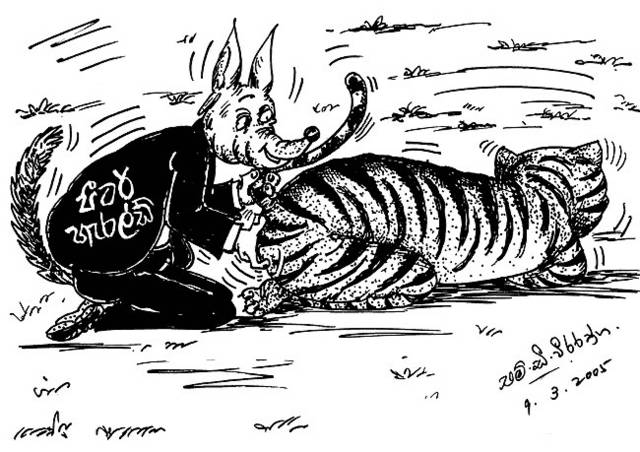
world Bank all out to please the LTTE Posted by Hello

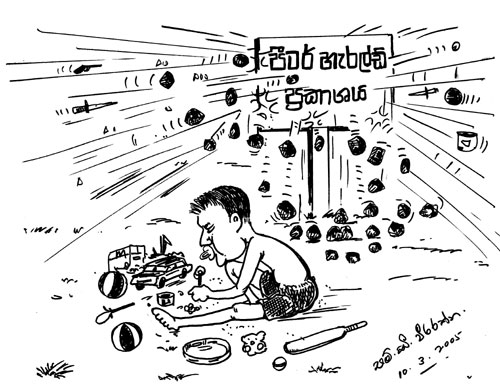
Peter Harold Draws Flack Posted by Hello

Wednesday, March 09, 2005

3 more killings in East by Senaka De Silva

The violence in the East continued yesterday with three more killings in Batticaloa, Eravur and Valachchenai, police said.

In Batticaloa, a former LTTE member identified as T. Tirubasewaran (36) was shot dead before dawn yesterday while he was waiting for a bus to get to Colombo airport and get away to Germany.

Batticaloa headquarters inspector Duncan Paul said Mr. Tirubasewaran had been threatened earlier and was trying to flee to Germany when two gunmen came on a motorbike and killed him.

In Eravur, 26-year-old Elian Ilangeswaran -- believed to be a member of the Karuna faction -- was allegedly abducted by the LTTE and shot dead in Vakarai, Inspector D. Ratnayake said.

In Valachchenai Sivarasan Ravindran -- also believed to be a member of the Karuna faction -- was shot dead allegedly by LTTE cadres.

Valachchenai Inspector M. K. Daramawardene said Mr. Ravindran, a businessman, was going to the bank when he was shot dead.

Meanwhile the Sri Lanka Monitoring Mission (SLMM) yesterday condemned the recent killings in the east as senseless and barbaric. But urged the government and the LTTE to maintain the Ceasefire Agreement.

"We condemn these barbaric and cowardly acts in the strongest possible terms," the SLMM said in a statement.

It said the violence had raised serious fears and created uncertainty around the country disrupting the peaceful life of Sri Lankans.

The SLMM urged the government and the LTTE not to let these acts of violence damage the Ceasefire Agreement.

"We strongly recommend that both sides unite in an effort to do all in their power to prevent these senseless attacks," the SLMM said.

The SLMM said it was conducting its own inquiries but it was the responsibility of the police to bring the killers to justice. The SLMM said it was only a monitor and would not conduct police investigations.

(http://www.dailymirror.lk/2005/03/09/front/3.asp)

3 more killings in East by Senaka De Silva

The violence in the East continued yesterday with three more killings in Batticaloa, Eravur and Valachchenai, police said.

In Batticaloa, a former LTTE member identified as T. Tirubasewaran (36) was shot dead before dawn yesterday while he was waiting for a bus to get to Colombo airport and get away to Germany.

Batticaloa headquarters inspector Duncan Paul said Mr. Tirubasewaran had been threatened earlier and was trying to flee to Germany when two gunmen came on a motorbike and killed him.

In Eravur, 26-year-old Elian Ilangeswaran -- believed to be a member of the Karuna faction -- was allegedly abducted by the LTTE and shot dead in Vakarai, Inspector D. Ratnayake said.

In Valachchenai Sivarasan Ravindran -- also believed to be a member of the Karuna faction -- was shot dead allegedly by LTTE cadres.

Valachchenai Inspector M. K. Daramawardene said Mr. Ravindran, a businessman, was going to the bank when he was shot dead.

Meanwhile the Sri Lanka Monitoring Mission (SLMM) yesterday condemned the recent killings in the east as senseless and barbaric. But urged the government and the LTTE to maintain the Ceasefire Agreement.

"We condemn these barbaric and cowardly acts in the strongest possible terms," the SLMM said in a statement.

It said the violence had raised serious fears and created uncertainty around the country disrupting the peaceful life of Sri Lankans.

The SLMM urged the government and the LTTE not to let these acts of violence damage the Ceasefire Agreement.

"We strongly recommend that both sides unite in an effort to do all in their power to prevent these senseless attacks," the SLMM said.

The SLMM said it was conducting its own inquiries but it was the responsibility of the police to bring the killers to justice. The SLMM said it was only a monitor and would not conduct police investigations.

(http://www.dailymirror.lk/2005/03/09/front/3.asp)

Saturday, January 08, 2005

Regimented Wanni wants help- not helpers by Tyronne Devotta

Tyronne Devotta, Deputy Editor with The Sunday Times, was the first journalist from the South to visit the tsunami-battered Wanni dominated by the LTTE. Here is his on-the-spot report.

Nature’s fury has kept the Tiger guerrillas much busier than the times during the near two decades of war they fought with the Sri Lankan security forces. I was greeted by heartrending scenes as I entered the heartland of the Tamil guerrilla controlled terrain – Mullaitivu - Friday (December 31) morning. Along the coast lay a vast swathe of destruction extending for miles.

Guerrilla cadres and relief workers pull out bodies from the debris – collapsed buildings, broken-down structures and fallen trees. The last rites are performed with an odd combination – kerosene and sugar. Makeshift pyres burn all round.

I walk around them. A few hundred yards away, a guerrilla cadre armed with an assault rifle is on a killing spree. He is shooting dead all the stray dogs he could see. He says they want to avoid the spread of disease. Worse enough, there have also been dogs feeding on human carcasses.

I had to obtain permission from the LTTE to enter the area. Civilians are required to obtain permission. They are selective. Those who get the clearance are inoculated and issued with face masks.

I walk past a collapsed building. My Tiger guide tells me that this was a home for children. Thirty-two had died on that day. Most of them were under three years.

The pyres exude a smell of burning flesh all around. My guide says he feels eerie. That was too much even for the battle-hardened one, a medic of all things. It was bizarre indeed. Night was engulfing the area. On the New Year’s eve, the only light to guide us came from the burning pyres. What a contrast to those glittering decorations of the years past.

As we move around, word is out that the Sea Tiger “Special Commander” Soosai is in the area. The presence of uniformed military cadres in the area proves it. Uniformed cadres are conspicuous by their absence. Most are in civvies. Soosai has been given the job of clearing the area fast. His men tell me that he has not slept for days now. He is personally supervising. Seeing Soosai was clear proof that reports of his parting ways with leader, Velupillai Prabhakaran, was again disinformation. Here he was, carrying out his leader’s orders. We were on our way back to Kilinochchi. As the headlight of our vehicle pierces the night air, we saw a stout figure in military fatigues. My guide excitedly whispers Soosai. That was how we spotted Soosai.

The worst problem it seems is the identification of bodies now bloated after being in the water for days. The next day, in another area, I found the dead were being dumped in mass graves. The stench was unbearable but the relief workers prodded on.

The injured had been moved to hospitals and even houses or open ground. Some of the serious cases have later been transferred to Vavuniya hospital after clearance was granted at the Army check-point. The Tigers have placed the death toll in their areas at over 20,000 with well over 12,000 missing.

It’s now two weeks since the tsunami struck the island; the shock and surprise caused by this enormous force from the sea have sunk in. The death toll and the damage it caused to property no longer make headlines.

Relief work is gradually turning into reconstruction – to build the shattered lives of the thousands living on the coastal belt of our country. A common disaster to the whole island, it struck in the so-called cleared and uncleared areas with no discrimination. But what was common in this disaster has not brought any common ground in the handling of relief work and plans for reconstruction. North-South mistrust still exists with the LTTE and the Government pointing fingers at each other.

The Tigers say the Government does not help them because of its alliance with the JVP. They say that 80% of the coast of the North and East is administered by the LTTE. They say that they have no hope for the rehabilitation of their fishermen because the Fisheries Ministry comes under the JVP.

The LTTE wants southern aid but wants control of it when it crosses the border. They are willing to be a part of the national disaster management programme but on their terms. LTTE's political wing leader S. P. Thamilselvan says “the hand of friendship extended by the South will be appreciated over time and will be viewed positively in the peace process”.

Even in disaster, politics seems to be taking the upper hand over relief or reconstruction. Politics of this tsunami even extends to the orphaned children – as to who would take charge of them. Just a few days after the disaster Sarvodaya Chief A.T. Ariyaratne visits the LTTE-controlled Wanni. His luxury Intercooler takes him to the media unit of the LTTE where he greets the head of the unit, Daya Master, with a loud “Vannakkam” and his first few sentences are in faltering Tamil. He has a plan for the orphaned children – the setting up of a centre in Mullaitivu to look after them. The plan, he says will extend until the children become majors and the funds for this project “no problem” he says. Daya Master is very polite. Dr. Ariyartne and his team are plied with cool Necto and at the end of the meeting Daya Master promises a meeting with Mr. Thamilselvan. The head of the Sarvodaya departs not knowing whether he has struck gold.

The aid is slowly coming in and it is centrally controlled by the Tamil Rehabilitation Organisation (TRO). All items that come in are documented carefully and stored in warehouses. As it is usual now key administration points for this disaster management is supervised by expat Tamils. Computer scientists, doctors, engineers are all actively involved in the processing and distribution of relief items. “There must be accountability in aid collection. Not a drop will go waste,” they say.

At the Tamil Health Organisation (THO), there are careful needs assessments being made for drugs and the right amounts are being bought and shipped to Sri Lanka by the Tamil Diaspora. There is aid coming from the South and there are complaints from officials of the Tamil Health Organisation that some of the items have passed the ‘best use before’ date. These items are separated and burnt. Slowly the presence of the international community and the world media is taking focus.

An Italian delegation who visited Mr. Thamilselvan with an aid package had only praise for the efficiency for this organization. The warehousing techniques are excellent, they said and “we are sure that these supplies will be used efficiently”. The disaster has not in anyway hampered the hospitality of the LTTE. Their ‘Tank View’ Guest house is packed to capacity with diplomats, international media and members of the Tamil Diaspora.

In the LTTE Peace Secretariat, Tamil expatriates gather data on the dead, injured and displaced in the eight districts of the North and East and compare them with the Government Agents' figures. They say they are evaluating needs at a ground level.

Ana Pararajasingham, Chairman of the Australian Federation of Tamil Associations says, “We are on ground zero. What they need is to be compensated, not to go to the pre-tsunami position. They should be given what had been denied to them due to the war. Aid should be equitably distributed in the North and South. If the Sri Lanka Government continues to ignore the North-East, it will only demonstrate that it is not interested in the well-being of the people of the North and East and I hope it does not stay that away and I hope the Sri Lanka Government rises above politics and helps in a humanitarian way.”

The Government has offered help to the LTTE. The guerillas, however, say they do not need helpers but only the help. The debate continues 14 days after the catastrophe.


The Indian Naval ship "Kutch", one of the Indian Military ressels involued in the relief effort at the Ashraff Jetty in Trincomalee.  Posted by Hello

State radio’s 'Prabha dead' story a dead rope

The LTTE dismissed yesterday a state-run Sri Lanka Broadcasting Corporation report that suggested its leader, Velupillai Prabhakaran and his intelligence wing leader Pottu Amman were missing and presumed dead after the tsunami catastrophe, saying it was not a time for false propaganda.

An official statement accused the SLBC of broadcasting reports that are "fabricated by interested parties" and added that they "strongly protested against the mischievous act".

The SLBC attributed its report to Chief of Defence Staff and Navy Commander Daya Sandagiri. However, Vice Admiral Sandagiri last night told The Sunday Times that he had not made the remarks.

Several foreign media outlets gave wide play yesterday to the report quoting the SLBC. However, last night the SLBC retracted its report.

JVP allegedly hijacking food convoys by Asif Fuard

JVP activists wearing red t-shirts, red caps and badges – with the words 'JVP relief services force', the JVP star symbol and in the center of which is a red cross – were seen collecting goods and medical items to be distributed among tsunami victims.

JVP volunteers are operating mainly in southern areas such as Galle, Matara, Hambantota and Tissamaharama. According to reports, the displaced people are unaware that some of the food items and medicines given to them by JVP volunteers have been allegedly 'hijacked' from relief convoys sent by various groups.

It is alleged some vehicles carrying relief were redirected into JVP stores. In one case, vehicles were diverted to the New Imasha film hall in the Hambantota town, instead of a Government store 5 km away. New Imasha film hall owner Nimal Kularatne said he did not know that the JVP was this food storage point for alleged political mileage.

"I am also doing relief work for tsunami victims. Some people calling themselves Sahana Seva Balakaya asked for my theatre to set up a medical centre. I did not know that the JVP was behind this and party members would put up banners all round my film hall," he said.

Mr. Kularatne said they wanted the hall for five days but were now staying on longer and he had heard some were watching films also in the theatre. At this film hall we saw vehicles from JVP collecting centres were coming and storing goods.

Most of the vehicles belong to ministries of JVP members, but they now carried JVP banners. A resident alleged that aid lorries coming from Matale to Hambantota were stopped JVPers and the drivers were told to put up JVP banners. If they refused, the drivers were assaulted and the vehicles hijacked.

Among the Ministerial vehicles used by the JVP were a bus bearing number JK-0194, tractors bearing numbers 49-6145 and 49-9623 and a lorry bearing number 253-3506. Despite the JVP having several collection centres and warehouses, we found that several refugee camps did not receive aid from the JVP relief service force but from other groups.

The JVP-run Tissamaharama Pradeshiya Sabha Chairman's coordinating secretary, S. Seneviratne, said 200 houses were being builts and would be completed within the next few days to give shelter to the displaced people and stocks would also be given to them.

The Sunday Times has also received reports, which say the JVP is trying to be the sole relief group by preventing others providing help and aid. With the JVP apparently trying to monopolise aid distribution in the south, a serious incident also took place at Goddauda in Dickwella, with JVP allegedly asking the army to withdraw from a refugee camp.

JVP Deepal Gunesekara siad besides members from the south, hundreds of JVPers from districts not affected by the tsunami had volunteered to work in the south. He said the party was operating some 12 medical centres for the refugees and 30 centres to collect goods in Hambantota.

He said party workers had cleared the rubble and would now start building houses for the fisher folk. At a time such as this when our brothers and sisters have come forward to re build our country we have kept politics aside and have stepped out to serve the affected people in their time of need," Mr. Gunasekara said.

Refugees shattered, receiving little or no aid
The displaced people in the eastern province are also facing a situation similar to the one faced by those living in refugee centers in the south. Even here the JVP is reportedly diverting food relief convoys to locations specified by them, instead of allowing them to be unloaded at government authorised centres.

The JVP volunteers wearing red shirts and red caps were seen to be involved in relief activities in refugee camps set up at the Jayasumanaramaya in the Trincomalee town which houses most of the refugees from Sirimapura and Abhayaramaya. Sirimapura a fishing village was washed away by the killer tidal waves. Some of the refugees said they are yet to receive food, clothing or soap even after several days in the camp.

The refugees held the JVP responsible for this situation charging that the needy were receiving little or no aid while those not in need received most of the benefits. It was sad and unfortunate to see refugees desperately queuing up for food being ignored when close by several three wheelers were seen nonchalantly transporting food parcels.

"We were sent by Trinco district MP Jayantha Wijesekera here. We refute the charges made against us as false. We are doing a solo job and no state help comes here. The government must intervene or soon these relief measures will cease. All we need to do therefore is to save whatever relief we get now", Indika Priyadharshana, a JVP relief worker said.

Rev. Sooriyagoda Piyananda Thera the viharadhdidpathi of the Sooriyaramaya temple who had brought relief items from Galenbindunuwewa confirmed the allegations leveled against the JVP. "These people are trying to boost their image and are not interested in real relief work. What we brought here too has been spirited away by outside elements in our very presence. People are disenchanted with this type of relief work", the Thera said.

World Solidarity Conference, Sri Lanka branch joint patron Rev. Mahagalkadawala Punyasara Thera was emotionally moved when he said:

"The relief that should be given to the refugees are getting into wrong hands and we ourselves saw it happen. Some refugees unable to see this display of selfishness are giving away their meals to other more deserving victims. Both organisations are attempting to boost their image and we decry this mentality".

Another relief organisation from the Wayamba said the JVP took over the distribution of the relief items they donated. This organisation said that if they had earlier known about this JVP interference they would have not brought the relief items there in the first place.

These matters were highlighted at a provinicial council meeting held on January 4 at Wayamba where SLFPers of the Sandhanaya and Oppositon UNPers condemned this attitude by the JVP.

Govt. slow boat for tsunami by Iqbal Athas

A joke now doing the rounds in Colombo's social circuit speaks of how the Tsunami Monitoring Centre in Hawaii was trying to make contact with local officials in the early hours of Boxing Day, December 26. They first called the Meteorological Department in Colombo. There was no response. Then they rang the Monitoring Centre in Pallekele near Kandy. There was no response there too.

Exasperated officials later telephoned the office of a leading Government politician. He was out on his morning walk. An aide picked up the message from a Honolulu official. There was a tsunami coming from Indonesia.

On the politician's return, the aide told him about the phone call. He said he had been informed by the US that Tsunami from Indonesia was arriving in two hours. The politician acted promptly. He ordered a delegation to be sent to the Bandaranaike International Airport with a paging board that said "Welcome to Sri Lanka - Mr. Tsunami of Indonesia."

The joke did not end there. After the tsunami had unleashed its fury leaving behind a trail of death and destruction, there was more. The story did the rounds that the same politician was told that Powell was coming to Sri Lanka. The reference, of course, was to US Secretary of State Colin Powell. But the politician got it wrong. He issued orders to promptly alert the Navy and the Police to evacuate people from the coastal areas.

Jokes apart, these tales clearly underscore the confusion and chaos that reigned in the Government after the deadly tsunami struck. The immediate responses to the tragedy came not from any state agency or the armed forces but from civilians. They retrieved the bodies, rushed the injured to hospitals and even cleared debris. Many of them were also offering medication.

It took the Government exactly eight days to post policemen and troops to guard centres housing displaced persons. That came almost by chance. At a top-level conference in Colombo, the story of how a young girl was saved by a group of people was being talked of. Later, one of them had pulled the girl out from an IDP (Internally Displaced Persons) Centre and raped her. The distraught girl had to go out of that area to make a complaint at the Kalutara Police Station. It was immediately decided that security presence was essential at IDP centres.

Nine days after the catastrophe Military Co-ordinating Officers were appointed to the 12 districts affected. They are: Ampara- Colonel Jagath Dias, Batticaloa - Vajira Wijegoonawardana, Colombo - Brigadier P. Chandrawansa, Galle - Rear Admiral K.B. Tennekoon, Gampaha - Captain G.E. C. Jayawardena, Hambantota - Commodore S.R. Samaratunga, Jaffna - Major General S.D. Tennekoon, Kalutara - Rear Admiral Wasantha Karannagoda, Matara - Major General Sharman Kulatunga, Puttalam - Colonel H.K. Gunarathne, Trincomalee -Major General Sumith Balasuriya and Vavuniya - Major General Parami Kulatunga.

The two measures - posting armed troops and policemen to IDP centres and the appointment of Military Co-ordinating Officers - no doubt has had a salutary effect. But the question remains why it came so late. It highlights the absence of any contingency mechanisms in place.

If President Chandrika Bandaranaike Kumaratunga was on a private visit to Britain, the Brahmins in the Ministry of Defence, who are quick to criticise the media from the comfort of their air-conditioned rooms, did little or nothing to take control of the situation. Hardly anything moved. Not until President Kumaratunga returned to the country and chaired a few conferences. Instead of a natural disaster, if it were to be a guerrilla attack, one would hate to imagine the consequences.

Last Tuesday I accompanied CNN's Chief International Correspondent Christiane Amanpour on a tour of the affected areas in the Batticaloa district. Soon after Squadron Leader Waruna Senaratne touched down on a Chinese built Harbin Y 12 at the SLAF base, we drove out to be greeted by the swathe of destruction. Hundreds of houses have been razed to the ground forcing occupants to flee to hurriedly set up IDP centres.

I visited one of them at St Michael's College in the town. Nine days after the catastrophe, more than 2,200 men, women and children were crowded there. More were coming in. Seven to eight families were being huddled together in every classroom. The overflow occupied the corridors. Adults and children were sleeping only on sheets of newspaper spread on the floor. Children in particular were wailing for food. Private individuals had cooked food and served only one meal a day. The quantities, many complained to me, were only a handful and was inadequate.They were starving. There were only four toilets in the complex. Twelve temporary ones had just been put up.

With the deployment of a team of soldiers and police, the Government machinery had got into full gear at this school. This was only on the ninth day after the catastrophe. Local officials were busy compiling a register of all those displaced. They queued up to take their turn to give personal details and relate their tales of woe. Each one of them had a sad tale to relate. Some had lost their parents, others their children or loved ones. Almost all had lost their belongings and had come to the centre only with the clothes they were wearing.

As the registration process went on, I saw a multi-religious delegation arrive at the IDP centre. It comprised representatives of Buddhist, Christian, Muslim and Hindu clergy. They began an assessment of the needs of the displaced. It turned out that Government help had not yet arrived. That is nine days after the catastrophe. But the good news was that the machinery was now moving and help was not far off.

Unlike some of the other affected areas in the East, still inaccessible, Batticaloa was not. But the Government machinery had not moved. This was the case in most of the other affected areas including the South. This is underscored by the experience of the top most military officer responsible for Sri Lanka's security forces - Chief of Defence Staff and Commander of the Navy, Vice Admiral Daya Sandagiri.

On Sunday (December 26), he turned up at his office in the Navy Headquarters to clear some urgent work. Minutes later, he received a telephone call from Deputy Eastern Naval Area Commander, Commodore Jayantha Colombage. He said there was an unnatural tide level. For a moment he pondered whether this was related to the full moon day (December 26) and was an astronomical tide. But Vice Admiral Sandagiri was told the water level had reached the floor of the office of the Commander, Eastern Naval Area - an approximate sea level rise of more than ten feet.

By then other reports about rising tidal waves were reaching Navy Headquarters from the South coast. Soon Defence Ministry and other Government officials were informed. Vice Admiral Sandagiri said on the first day itself the Army despatched 5,000 packets of food to the South. The Navy joined in by providing a further 3,000 packs. He said he inducted 500 sailors who had been awaiting their passing out on December 29 having completed their training. They had cleared the road from Boosa to Galle.

Vice Admiral Sandagiri said he visited Galle, Matara, Hambantota and Kirinda three days after the catastrophe. In Galle, he saw people stopping lorries loaded with relief supplies. They took away the items. He felt there was an immediate need to co-ordinate the supplies, he pointed out. In Hambantota, students from the Moratuwa University had already arrived and were engaged in relief operations. They were helping to move out to various areas supplies sent by private parties and NGOs. A weekly Pola held on Sundays drew large crowds. This time the vendors and those who came there were all gone.

In Kirinda, Vice Admiral Sandagiri said, the Naval Sub Unit was no more. The only structure that remained was a small building. The Officers' Mess was no more and the billets that accommodated soldiers had virtually disappeared. He said arrangements were being made to re-build the camp.

It is in this backdrop that President Kumaratunga last Tuesday named three different task forces - one for rescue and relief (TAFRER), one for Rebuilding the Nation (TAFREN) and the other for Logistics, Law and Order (TAFLOL). The first is chaired by Dr Tara de Mel, the second by Mano Tittawella and the third by Tilak Ranaviraja.

If these task forces are vested with responsibilities relating to state and private agencies locally, co-ordination of all foreign relief teams has been placed in the hands of the Commissioner General of Essential Services (CGES), Tilak Ranaviraja. He is also Secretary to the Ministry of Public Security, Law and Order. Mr Ranaviraja also chairs the Task Force on Logistics, Law and Order.

In his capacity as Commissioner General of Essential Services (CGES), the responsibility of co-ordinating all assistance provided by military teams from several countries has fallen on him. Conspicuously the Secretary to the Ministry of Defence, former North-East Governor, retired Major General Asoka Jayawardena, has not been named for any of these committees.

Among the foreign military teams with which Mr. Ranaviraja is now co-ordinating activity are those from the United States, India, Pakistan, Bangladesh, China, France, Israel, Italy, Britain and Canada. In addition CDS Vice Admiral Sandagiri is also holding daily meetings with some of the Defence Attaches who represent countries that have sent military teams.

Besides military teams, several other countries have also despatched relief/medical teams. They include those from Austria, Australia, Abu Dhabi, Belgium, Thailand, Brazil, Bahrain, Dubai, Egypt, Germany, Holland, Japan, Korea, Kenya, Malaysia, Oman, Spain, Sweden, the United Arab Emirates, Slovakia, Turkey and Tanzania.

Now, slowly but surely relief is pouring into the affected areas. But the biggest question for the Government still remains. It has to ensure they reach the needy and does not end up in unscrupulous hands.

Navy to rebuild fisheries industry
The Government has called upon the Sri Lanka Navy to undertake an urgent multi million rupee fibre glass boat (FGB) building project. This is to help fishermen who have lost their boats and thus their livelihood in the North, East and the South due to the tsunami catastrophe.

"These boats, 17 foot and 27 foot long, will be manufactured in Colombo, Trincomalee and Galle," Chief of Defence Staff and Commander of the Navy, Vice Admiral Daya Sandagiri told The Sunday Times. He said in terms of a Cabinet decision, the Navy would undertake the boat-building project on a priority basis.

Besides building new boats, Vice Admiral Sandagiri said Naval teams are also being assigned to visit coastal areas to repair damaged boats. For this purpose, statistics of repairable boats are now being collected by Navy Headquarters.

In an interview with The Sunday Times Vice Admiral Sandagiri answered questions relating to the tsunami and the relief efforts now being carried out by the security forces. Here are excerpts:

On reports that the Navy had received a tsunami warning from a monitoring centre in Hawaii:

This is utter rubbish. There was no such thing. In fact some were trying to extend this rumour further by saying I had told a foreign TV net-work that I was aware of a warning. Thereafter even a local newspaper reported on this. There is absolutely no truth in this.

Appointment of Military Co-ordinating Officers for affected districts:

Usually Military Co-ordinating Officers are appointed when the Government machinery at district level fails. But this one is different. These MCOs have been tasked to work closely with the Divisional Secretaries (Government Agents) who have been appointed as Competent Authorities. The primary task is to ensure the proper co-ordination of relief supplies. MCOs have assigned armed forces officers to be in charge of a cluster of camps housing internally displaced persons. It is the latter's responsibility to report on the shortcomings to their respective MCOs. They in turn will keep the Divisional Secretaries briefed.

The MCOs are vested with full powers to deal with any situation. President Chandrika Bandaranaike Kumaratunga already directed that the Divisional Secretaries should meet every day with the MCOs to discuss the prevailing situation and take whatever action necessary to overcome problems.

On restoration of normalcy:
Armed forces and Police functioning under the MCOs have been told to provide whatever assistance required in this regard. One task before the Navy is the commencement of a priority project to build fibreglass boats for use by fisherman. In addition we are also sending out teams to coastal fishing villages to carry out on-the-spot repairs on boats damaged. We want to make sure the fishing industry returns to normal without much delay.

I must make clear that the deployment of armed forces personnel is by no means a military takeover. Their role is to assist the civilian authorities. We are also helping the Police in the maintenance of law and order.
This is why troops have been deployed in camps housing displaced persons. We want to ensure they are protected.

(http://www.sundaytimes.lk/050109/columns/sitrep.html)

Friday, January 07, 2005

Special coffin to the Tigers'

Tigers' Organisation is reported to have placed an order for an extraordinary coffin with a foreign country.

The Tigers' Organisation says that this coffin was ordered for the funeral of a Sea Tiger leader who was third in rank and fell prey to the tidal waves.

But intelligence sources have received information that Tiger leader Velupille Prabhakaran was reportedly killed by the tsunami tidal waves and this special coffin was intended for his funeral.

Velupille Prabhakaran has attended the special Sunday Service held at Mullative church on 26th last December and all those present at this special Service are reported to have been killed by the tsunami waves.

Intelligence sources say that outsiders were not allowed entry into the Mullative jungle in fear that this shocking revelation will cross its boundaries. However Intelligence sources say that they are still receiving information in this regard.


(http://www.lankatruth.com/news/01_10_jan_05/full_story-0107_6.htm)

Tsunami flushes out bulk of Sea Tiger assets by Shamindra Ferdinando

Sunday’s sea-borne terror had caused considerable damages to security forces, particularly the navy and the sea tigers, security officials said. The navy’s losses had been on the southern coast while the sea tigers’ on the eastern coast.

Security forces and the LTTE suffered sizeable equipment losses, an official said. There had been significant loss of arms, and ammunition too.

They would also have to detect and neutralise mines that had been moved by the raging waters before ‘deploying’ fresh mines as part of their defences.

But Sea Tiger losses would have been unprecedented, the official said, emphasizing the giant tidal waves that decimated the LTTE-held parts of eastern coastline wouldn’t have spared the Sea Tigers. Most of their assets are based on the east coast with Mullaitivu-Chalai being their stronghold.

“Their vessels wouldn’t have a chance against the waves,” the official said. He expressed the belief that at least half of the sea tigers’ operational vessels would have been crippled by the giant tidal waves.

A senior security official said that the LTTE would not acknowledge, particularly their equipment losses. “We are convinced that they would not be able to restore most of the crippled vessels. But we are not gloating over their losses but merely assessing the impact the sea-borne terror had on the sea tigers,” he said.

The raging waters also washed off the Nilaveli navy base and the Muttur detachment. The navy, despite losing their base, managed to save the artillery and also a number of vehicles. But small arms, ammunition and communication equipment had been lost. “We lost two personnel at Nilaveli and Muttur,” a senior official said, revealing the navy rescued over 100 Tamils and Muslims from furious waters.

The navy wouldn’t vacate the affected areas. “We’ll stay put,” an authoritative official said, adding, “Leaving Nilaveli and Muttur wouldn’t be an option. “We are in the process of consolidating our positions. We’ll not ignore that need despite our heavy involvement in relief operations,” he said.

Answering questions, a high ranking official said, “It’s a miracle we didn’t lose any vessels based at Trincomalee. Over 75 percent of the vessels including Fast Attack Craft are Trincomalee based. Sunday’s tsunami would have crippled the majority of our vessels if we didn’t swing into action promptly.”

“We never expected a natural disaster of his magnitude,” he said. But a plan that had been in place to be implemented in the event of a major LTTE assault on the Trincomalee base ensured the rapid launching of vessels.

Otherwise our losses would have been greater than what we lost in a series of confrontations over a period of time, another official said. “It could have reduced us to a ship-less navy,” he said.

The navy bases Kirinda and Galle (Dakshina) too had been washed off. The navy lost two vessels, a Chinese built Sub Chaser (SLNS Parakramabahu) in service since early 1996 and a Landing Craft (L 820) also acquired from China. Both losses had been reported from Dakshina.

Navy headquarters said that a dozen personnel including the officer (Lieut. Commander) in charge of the KKS harbour defence and the Officer-in-Charge (Lieut.) in charge of the Manthai detachment.

Airforce headquarters said that Sunday’s sea-borne terror hindered its operational capability. “In fact we weren’t really affected,” a spokesperson said, adding that the Koggala runaway had been flooded. The SLAF base at China Bay had been affected. “But that was temporary,” he said, adding that all available choppers and fixed wing aircraft were operational.

The STF headquarters said that police commandos were in the process of consolidating their positions at Komari, Akkaraipattu and Arugam Bay. The waters had washed off the Komari base. The bases at Akkaraipattu and Arugam Bay had suffered considerable damages. A senior STF spokesperson said that commandos wouldn’t abandon any of these bases.

The army had lost four officers including a Lieutenant Colonel and fifty five other personnel. Army bases at Kalkudah (Brigade Headquarters), Kayankerni and Mankerni in the Batticaloa district and the bases at Point Pedro, Valvettiturai and Nagarkovil had been washed off. Their frontline defences at Nagarkovil in Vadamaratchchy too had been washed off. “We are in the process of restoring them,” a senior official said, adding that the nearby LTTE fortifications too had been washed off.

(http://www.island.lk/2004/12/29/news3.html)

LTTE radar flattened by Norman Palihawadane

Four LTTE radar stations were levelled to the ground following the December 26 tidal wave, security sources said.

Around 200 boats belonging to the LTTE’s Sea Tigers had been washed out to the sea, sources said.

Security analysts said that according to the available reports an LTTE armoury in Mulaithivu too was destroyed by the tidal waves.

According to LTTE’s peace Secretariat sources, the total number of deaths upto Saturday was 16,656 while another 18,481 persons had gone missing. They said that 155,912 families were displaced by the tsunami catastrophe.

In the Ampara District alone 11,225 were dead and another 6000 missing, sources said.

The LTTE has set up 300 welfare centers in affected areas under their control, sources added.

(http://www.island.lk/2005/01/03/news2.html)